

Medicaid & CHIP Billing Strategies Every Pediatrician Should Know

Not because rates are low, though they are. Because billing is leaving money on the table your practice is entitled to collect.
Most pediatric practices treat Medicaid and CHIP as unavoidable financial losses. They budget for low reimbursement, accept denials, and move on. But a lot of that lost revenue is not about rate structures. It is billing errors, missed codes, documentation gaps, and payer-specific rules nobody on the billing team was trained on.
The pediatric practice down the street with your exact same payer mix might be collecting 20 to 25 percent more on the same services. Not from better-negotiated rates. From billing correctly.
This guide covers what actually goes wrong in Medicaid and CHIP billing, the strategies that recover lost revenue, and what needs to happen before the next claim goes out.
Why Medicaid and CHIP Billing Fails Pediatricians So Often

Pediatric Medicaid and CHIP billing fails in very specific ways, not vague ones that catch most practices completely off guard.
Texas Medicaid Is Not One Thing
Most practices treat Texas Medicaid as one program with one set of rules. It is not. Texas Medicaid runs through multiple managed care organizations, Superior Health Plan, Molina Healthcare of Texas, Community Health Choice, Aetna Better Health of Texas, UnitedHealthcare Community Plan. Each has its own prior auth requirements, fee schedules, documentation expectations, and appeal procedures.
A prior auth requirement at Superior may not exist at Molina. A code Aetna Better Health covers freely may need additional documentation at Community Health Choice. Billing all of them the same way guarantees unnecessary denials.
CHIP Is Even More Plan-Specific
CHIP in Texas has its own benefit limitations, cost-sharing rules for families above certain income thresholds, and prior auth requirements that differ from Medicaid. Practices that treat CHIP claims identically to Medicaid claims will see CHIP-specific denials that nobody can explain because nobody looked at the CHIP plan rules to begin with.
Preventive Care Is the Most Under-Billed Category
Well-child visits are also the most systematically under-billed service in Medicaid and CHIP billing.
When a child comes in for a well-child visit and presents with an acute concern, ear infection, rash, cough, that is two billable services. A well-child visit code and a sick visit E/M code with Modifier 25. Many practices bill only the well-child and miss the sick component entirely. Others bill both incorrectly and get the sick visit denied.
Medicaid and CHIP cover both when they are genuinely separate services with documentation that reflects each distinctly. If the note only describes the well-child exam, the sick visit denial is correct, the documentation does not support it.
Vaccine Billing Is a Consistent Revenue Leak
Every practice bills vaccines. Not every practice bills them correctly under Medicaid and CHIP.
Three places this fails. First, administration code selection, 90460/90461 versus 90471/90472 depends on whether counseling was provided. Medicaid plans audit this distinction specifically. Second, vaccine product codes must match the specific vaccines given, which breaks when a formulary NDC update changes and claims start bouncing back. Third, VFC program doses must go out with a zero dollar vaccine product amount. Billing acquisition cost for a VFC-supplied vaccine is a compliance issue that many practices have not resolved.
Billing Strategies That Move the Revenue Needle
Know Each MCO Before Billing Them
Your billing team needs a reference document for every MCO your practice participates with, not a generic overview, but a specific record covering:
Prior authorization requirements by service type for that MCO
Timely filing deadlines — these vary by MCO and missing them means no appeal will work
Documentation requirements for commonly billed services
Covered vs. non-covered services specific to that plan
This does not exist as a single document anywhere. It has to be built from each MCO's provider manual, which every MCO is required to publish. Most billing teams do not read them. The practices that do have meaningfully lower denial rates.
Bill Preventive and Sick Visits Correctly on the Same Day
Rules for same-day billing under Medicaid and CHIP:
The sick visit must be separately identifiable, distinct history, exam, and clinical decision-making
Modifier 25 must be on the E/M sick visit code
The note must reflect both services separately, a blended narrative gets the sick visit denied
Some MCOs also require a modifier on the preventive code, verify per plan
If your practice sees 300 well-child visits per month and 30 to 40 percent include a sick component that is missed or incorrectly documented, that is 90 to 120 additional E/M claims per month going unbilled or denied.
Developmental Screening — Stop Leaving This Money Behind
Medicaid and CHIP cover developmental screenings under EPSDT. CPT 96110 covers the screening, 96112 is the add-on for extended complexity. Many practices perform these at every well-child visit. Not all bills for them. Of those that do, many document them wrong, "screening performed, appropriate for age" gets denied. The note must name the tool (M-CHAT, ASQ, PEDS), record the result, and document the follow-up plan.
EPSDT Is Broader Than Most Practices Use It
EPSDT is not just about screenings. It is a federal coverage mandate. If a Medicaid-enrolled child needs a medically necessary service and an MCO denies it as "not covered under our plan," EPSDT may require coverage regardless. Practices that understand this appeal those denials citing EPSDT obligations and win them.
Services frequently and wrongly denied where EPSDT applies:
Behavioral health assessments and follow-up
Vision and hearing services
Nutritional counseling for developmental concerns
Certain therapeutic services ordered by the pediatrician
If your billing staff is accepting these denials as final on Medicaid claims for children, revenue is walking out the door.
Timely Filing — The Denial You Should Never Get
Timely filing denials are preventable. Every MCO has a submission deadline, missing it makes the claim unpayable regardless of how perfect the coding is.
Verify current deadlines directly with each MCO — these change. A claim in a queue three months post-service may already be past one MCO's window while still within another's. Your billing team needs to know each plan's deadline and track against it actively.
Prior Authorization Management
Prior auth is where most Medicaid billing problems start. A service is delivered without required authorization, the claim is denied, retroactive auth is almost never granted, and the revenue is gone.
The fix is a real tracking system, not a mental note, that:
Flags services requiring auth before scheduling, not before billing
Tracks authorization numbers, effective dates, and approved visit counts
Alerts the team when auths are running out before the patient's next appointment
Missed prior auths on high-volume Medicaid practices can cost tens of thousands per year in claims that are never recoverable.
Documentation Mistakes That Keep Getting Pediatricians Denied
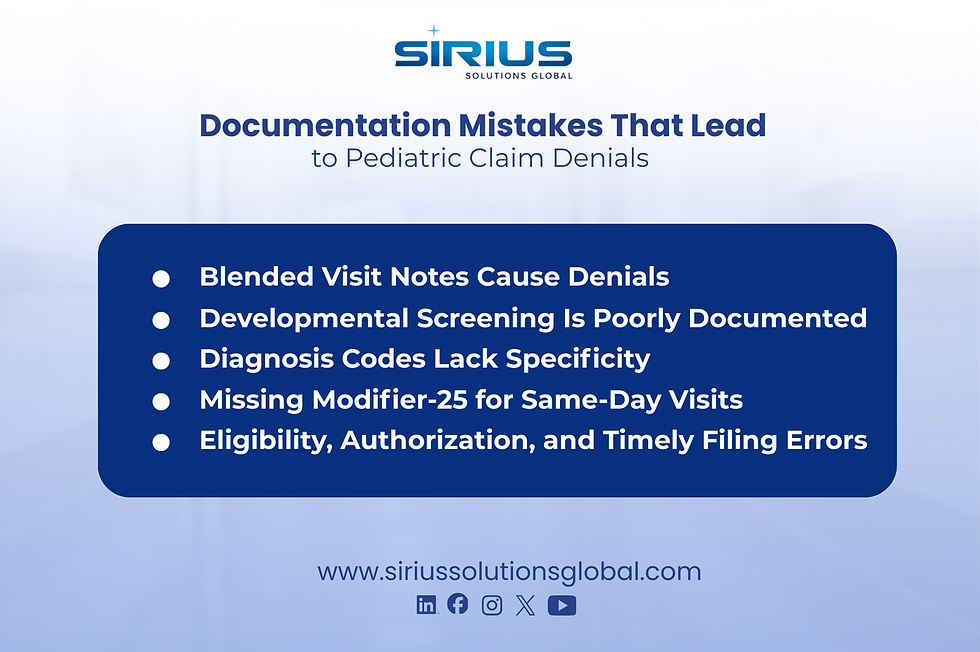
The Blended Note Problem
A single flowing narrative that covers both a well-child visit and an acute complaint will almost always result in the sick visit being denied. Medicaid and CHIP reviewers look for distinct documentation of two separate services, a complete preventive history and exam plus a separate history, exam, and clinical decision-making section for the acute problem. Mentioning the ear infection somewhere in the middle of the well-child exam documentation is not enough. The services need to be clearly distinct in the record.
Vague Developmental Screening Documentation
"Developmental screening performed, appropriate for age" is not documentation. An auditor will reject it. The note needs to name the specific tool used, record the result or score, and document what clinical action was taken, referral, watchful waiting, follow-up at the next visit.
Missing Diagnosis Code Specificity
Medicaid and CHIP require ICD-10 codes at the highest specificity available. Z00.129 works for a routine well-child with no findings. If there are findings, Z00.121 is more accurate. If a chronic condition is being managed, that diagnosis needs to be on the claim. Unspecified codes trigger additional scrutiny and generate avoidable denials.
Pre-Submission Checklist for Every Medicaid and CHIP Claim
Eligibility verified for this date of service — Medicaid eligibility changes month to month
Correct MCO identified — Confirm which plan covers the patient on that specific date
Prior authorization confirmed — Auth number on claim, valid for this date and procedure
Modifier 25 on sick visit if billed same day as well-child, with documentation supporting both distinctly
Correct vaccine administration code — 90460/90461 vs. 90471/90472 based on counseling
VFC vaccine product at $0 — If VFC-supplied, product code bills at zero
Developmental screening documented fully — Tool named, result recorded, follow-up noted
Timely filing deadline checked — Claim submits within the MCO's window
Diagnosis codes at highest specificity — No unspecified codes where specific ones exist
The Revenue Math: What This Costs a Typical Texas Practice
A practice seeing 400 Medicaid and CHIP visits per month with these billing gaps is likely losing:
Annualized: $73,000 to $151,000 — not from low rates, from billing that can be fixed.
How Sirius Solutions Global Handles Medicaid and CHIP Billing
Medicaid and CHIP billing for pediatric practices is where the gap between a specialty billing company and a generalist shows up most clearly.
At Sirius Solutions Global, every Medicaid and CHIP claim goes through payer-specific review before submission. We track current MCO requirements, prior auth rules, and timely filing deadlines. Eligibility is verified at the claim level, not just at check-in. Prior authorizations are tracked proactively before they lapse.
Developmental screening codes, EPSDT-covered services, and same-day preventive and sick visit billing are handled correctly because our team is trained on pediatric coding specifically. When denials arrive, appeals are built around EPSDT obligations and MCO-specific procedures, not generic reconsideration requests.


