

Ultimate Guide to CPT Code 97530: Avoid Costly Audits


Therapy practices lose thousands of dollars every month on CPT 97530 denials. This code gets audited more than almost any other rehabilitation service, and the reason is always the same. Documentation fails to prove the activity was truly functional.
Payers see confusion everywhere. Therapists bill 97530 for exercises that should be coded as 97110. Notes lack the detail needed to justify medical necessity. Time calculations do not add up. Modifiers get skipped or misused.
This guide explains everything about CPT 97530. You will learn what counts as a therapeutic activity, how it differs from therapeutic exercise, what documentation prevents denials, and how to bill it correctly under Medicare rules.
What Is CPT Code 97530?
CPT 97530 covers therapeutic activities that improve functional performance through dynamic, task-based interventions.
The official description reads: "Therapeutic activities, direct one-on-one patient contact, each 15 minutes."
This is a timed service billed in 15-minute units. You must follow Medicare's 8-minute rule. The therapist works directly with the patient during the entire period on activities that train real-world tasks.
The code focuses on function, not just movement. You are teaching the patient to perform actual daily activities, not isolating muscles or joints.
Key features include direct patient contact, dynamic movement patterns, functional goals tied to daily living, and skilled clinical judgment throughout.
For example, a stroke patient practicing shelf reaches is not just doing shoulder exercises. They are training the specific pattern needed for dressing and cooking. That functional focus defines 97530.

When Should You Use CPT Code 97530?
Use this code when treatment trains a patient to perform functional tasks needed for daily living, work, or community participation.
The activity must address a documented functional limitation. General conditioning or fitness training does not qualify. The patient must need skilled supervision to perform the activity safely and effectively.
Medical necessity requires:
A clear functional deficit in the medical record
A therapeutic activity that directly addresses that deficit
Progress toward measurable functional goals
Common conditions treated with 97530:
Stroke affecting movement patterns for self-care
Brain injury impacting safety during daily tasks
Parkinson's disease limiting transfers and mobility
Joint replacement recovery for functional activities
Orthopedic injuries preventing work tasks
Balance problems increasing fall risk
Developmental delays in children affecting play or self-care
Each condition creates functional challenges that isolated exercises cannot fully solve. The patient needs practice doing actual tasks under professional guidance.
Examples of Therapeutic Activities
Understanding what qualifies prevents coding mistakes.
Valid activities include lifting and carrying to simulate work demands, toilet transfers to improve bathroom safety, reaching at multiple heights for dressing tasks, dynamic balance during functional movements, car transfers for community mobility, bed mobility training, stair climbing with objects, and kitchen tasks requiring coordination.
The activity itself does not determine the code. Your notes must explain why it improves function.
Wrong: "Patient did sit-to-stand exercises 10 times."
Right: "Patient practiced toilet transfers to address bathroom safety. Required moderate cues for weight shift and minimal assist for balance. Completed 10 repetitions. Improved control versus last session."
The second version shows functional intent, skilled help, assistance level, and progress. Payers need all of that.
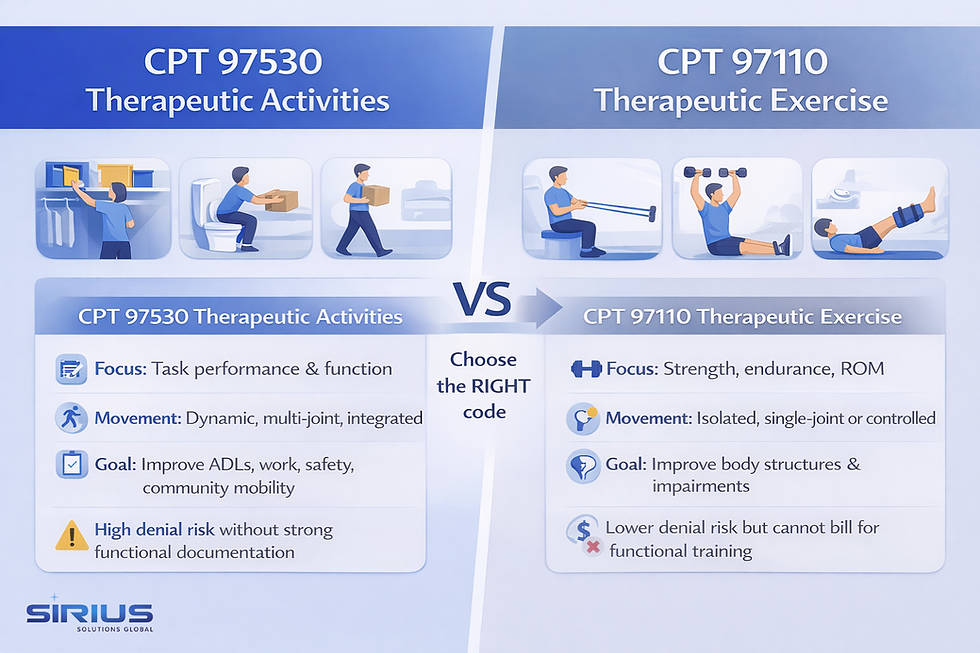
CPT 97530 vs CPT 97110: The Critical Difference
This creates more billing errors than anything else in therapy coding.
CPT 97110 builds strength, endurance, or range of motion through isolated movements. You are working on body structures.
CPT 97530 trains functional task performance through dynamic, integrated movements. You are working on activities the patient needs to do.
Intent determines the code. Training shoulder strength for future dressing ability is 97110. Having the patient practice actual dressing movements is 97530.
Many sessions include both. Document them separately with different times and goals. Never combine them or payers will downcode everything.
Billing Rules for CPT Code 97530
CPT 97530 follows strict time rules that you cannot bend.
Bill in 15-minute units using Medicare's 8-minute rule. You need at least 8 minutes for one unit. For multiple units, reach the midpoint of the next period.
8 to 22 minutes equals 1 unit
23 to 37 minutes equals 2 units
38 to 52 minutes equals 3 units
53 to 67 minutes equals 4 units
Most commercial payers use this same standard. Check specific policies for Medicaid programs.
What time does not count:
Setup or cleanup
Rest breaks without skilled intervention
Documentation time
Supervising another patient
Only bill minutes of direct therapeutic activity. If you step away, stop the clock.
Track time carefully using timers or start and stop documentation. This creates proof for audits and ensures accurate billing.
Documentation Requirements for CPT 97530
Strong notes separate paid claims from denials.
Every note needs:
Specific activity performed, not just the body part
Functional goal being addressed
Skilled therapist involvement shown clearly
Level of assistance or cueing provided
Objective progress or patient response
Total timed minutes
Vague documentation fails. "Patient worked on transfers" means nothing.
Compare to: "Patient practiced toilet transfers with controlled lowering. Required contact guard assist and verbal cues for hand placement. Completed 8 reps. Shows improved control versus initial eval."
That proves medical necessity and skilled service.
Sample documentation:
"Therapeutic activities, 30 minutes: Patient performed simulated kitchen tasks including overhead cabinet retrieval to address meal prep goals. Required dynamic standing balance, bilateral coordination, and postural control. Therapist provided tactile cues for trunk alignment during reaching. Patient needed moderate assist for balance recovery on overhead reaches. Completed 15 reaching reps at various heights. Improved stability versus prior session with balance loss reduced from 6 to 3 attempts."
This includes activity, goal, skilled work, assistance level, reps, time, and progress. It passes any audit.

Using CPT 97530 With Other Codes
You can bill 97530 with other therapy codes on the same day if each has distinct goals and separate time.
Common pairings include 97530 with 97110 for functional training plus strengthening, 97530 with 97140 for activities plus manual therapy, and 97530 with 97112 for task training plus neuromuscular work.
Documentation must separate each service clearly.
Example: "97110, 15 minutes: Resistance bands for shoulder strength to support reaching. 97530, 30 minutes: Functional reaching to shelves at varying heights for kitchen independence."
Different goals justify both codes.
Check National Correct Coding Initiative edits before billing. When edits exist, modifier 59 or X-modifiers may be needed to show distinct services.
Never bill multiple units of the same code for activities you could combine. This looks like unbundling.
Modifier Requirements for CPT 97530
Modifiers provide critical information to payers. Missing them causes denials.
Modifier 59 shows distinct procedural services when codes might appear bundled but were actually separate and medically necessary.
Use it for separate encounters on the same day, different body areas, distinct functional goals, or when CCI edits require proof of separate services.
Do not overuse modifier 59. Only apply it when notes clearly support distinct services.
X-modifiers give more detail than 59:
XE for separate encounter
XS for separate structure
XP for separate practitioner
XU for unusual non-overlapping service
Use these when payers accept them.
GP, GO, and GN modifiers identify the discipline:
GP for physical therapy
GO for occupational therapy
GN for speech therapy
Medicare requires these on all therapy claims. Many commercial plans do too. Apply the modifier matching the treating discipline.
Common Billing Mistakes That Cause Denials
These errors create most therapeutic activities denials.
Insufficient functional detail: Notes read like exercise descriptions. Payers downcode to 97110 or deny for lack of medical necessity.
No functional context: The note says what happened but not why it matters for daily function.
Overlapping time: Time for 97530 overlaps with 97110 or other services. Total minutes do not add up.
Missing modifiers: Claims lack required GP, GO, or GN modifiers.
Cloned notes: Identical language session after session suggests services are not truly needed.
Vague assistance levels: Writing "patient required help" instead of minimal, moderate, or maximal assist.
No objective measures: Failing to document progress makes payers question medical necessity.
Audit claims quarterly. Find these patterns and fix them before denials stack up.
Reimbursement for CPT Code 97530
Payment varies widely based on payer, location, provider type, and documentation quality.
Medicare rates for 2025 range from $28 to $45 per unit depending on geographic area. Non-facility rates run higher than facility rates.
Commercial payers negotiate their own schedules. Rates typically range from $25 to $60 per unit.
Medicaid programs set state-specific rates, often 30 to 50 percent below Medicare in low-reimbursement states.
Payment factors include:
Geographic location
Provider credentials
Documentation quality
Modifier usage
Medical necessity strength
Strong coding and documentation protect full reimbursement. Poor practices leave money on the table.
Best Practices for Clean Claims
Build systems that reduce denials and maximize revenue.
Always tie activities to functional goals explicitly. Make the connection to ADLs, work, or mobility obvious in every note.
Separate 97530 from 97110 clearly using different language. Exercises focus on body structures. Activities focus on functional tasks.
Track time precisely with timers or start and stop documentation. Never estimate later.
Update goals as patients progress. Repetitive goals that never change signal lack of progress.
Vary documentation language. Avoid copying identical phrases session after session.
Document assistance levels with standardized terms. Be consistent.
Include objective measures like reps, distance, time, or assistance level. Show change over time.
Review notes before submission. Have someone audit a sample monthly.
Who Can Bill CPT Code 97530?
Several professionals can bill this code within their scope of practice.
Eligible providers include physical therapists, physical therapist assistants under supervision, occupational therapists, certified occupational therapy assistants under supervision, and speech-language pathologists when activities address communication or swallowing.
The activity must fall within professional scope. Physical therapists focus on mobility. Occupational therapists address daily living activities. Speech pathologists work on communication.
Do not bill outside your licensed scope even if you have skills. Payers deny when provider type does not match the service.
Therapy assistants must work under appropriate supervision per state laws and payer policies. Verify whether payers accept assistant claims and at what rate.
Why This Code Gets Audited
Payers scrutinize 97530 more than most therapy codes.
Widespread confusion with exercise codes leads to inappropriate billing. Higher utilization raises flags. Vague documentation across the industry makes verification difficult.
Audit triggers include:
High percentage of therapy units billed as 97530
Same units every session regardless of patient needs
Identical notes across multiple dates
Billing without clear functional context
Frequent modifier 59 use without support
Significant billing increases versus prior periods
Clean documentation is your only defense in audits. You cannot explain verbally. The written record must stand alone.
Detailed, specific, functional notes prove medical necessity. They show skilled service and patient progress. Generic notes cannot defend against recoupment.
Partner With Sirius Solutions Global
Therapy billing creates constant challenges. Coding rules change. Payer policies shift. Staff training takes time. Denials eat revenue.
Sirius Solutions Global specializes in therapy and rehabilitation billing. We understand CPT 97530 and other rehab codes deeply. We know what documentation payers require. We track policy changes across all payers.
Our pre-claim audits catch errors before submission. We apply correct codes and modifiers for each payer. We appeal inappropriate denials with strong clinical support. We train your therapists on compliant documentation. We analyze coding patterns to identify risks.
Our therapy denial rate averages under 6 percent, well below the 15 to 20 percent industry standard.
While general billing companies like MedBillMD, CareCloud, AdvancedMD, athenahealth, and Kareo handle multiple specialties, we focus specifically on therapy billing. Our team includes certified coders with expertise in PT, OT, and SLP billing.
We optimize your entire revenue cycle from eligibility verification through patient billing. Every step is handled by therapy billing specialists.
Our solutions scale from solo practitioners to multi-location groups.
Ready to improve your therapy billing? Contact Sirius Solutions Global for a free revenue cycle assessment. We will show you exactly where your billing loses money and how we fix it.
Learn more about our crisis psychotherapy billing services and complete behavioral health revenue cycle management.


