

Michigan TCM Billing in 2026: Is Your Practice Ready for Medicare Advantage?


By Sirius Solutions Global — Healthcare Billing & Revenue Cycle Management
As of the August 2026 CMS MA State/County Penetration report, Michigan has the highest Medicare Advantage penetration of any state in the report, at 63.7%. That figure measures the share of the Medicare population captured in that CMS report who are enrolled in a Medicare Advantage plan it is not a statement about Michigan's total population, and it is not a guarantee that any individual practice's payer mix looks the same way. A clinic in one county may see a very different mix than one two counties over.
Still, the number is a reasonable signal: a Michigan practice billing Transitional Care Management (TCM) is likely to encounter Medicare Advantage patients regularly, not occasionally. And that matters, because knowing the patient's payer is only the first step. TCM is a Medicare billing service built around a strict post-discharge timeline, and that timeline doesn't pause to accommodate a payer lookup that should have happened on day one.
This article walks through what TCM actually requires, how CPT 99495 and 99496 differ, why Michigan's Medicare Advantage mix deserves attention without becoming a source of unnecessary alarm, and how a practice can build a workflow that holds up against the clock TCM runs on.
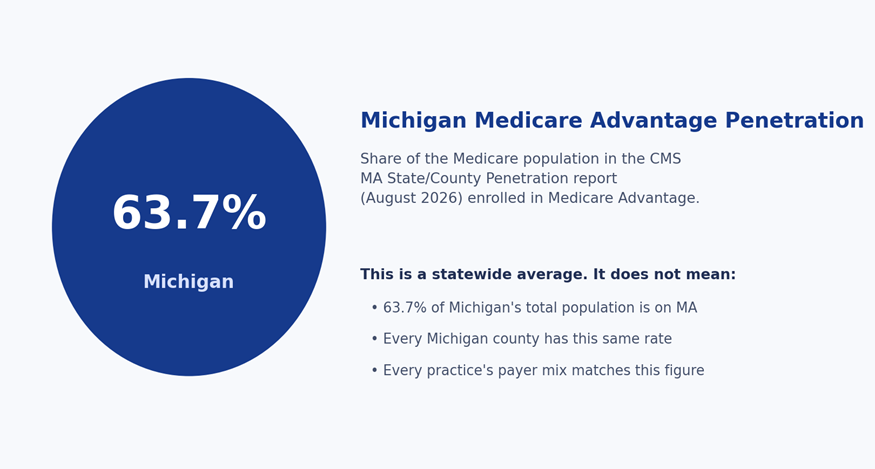
Source: CMS MA State/County Penetration report, August 2026.
What Is Transitional Care Management?
In short: Transitional Care Management is a Medicare-covered service that reimburses a physician or qualified practitioner for managing a patient's care during the 30 days following discharge from a qualifying inpatient or facility-based setting back to the community.
TCM combines non-face-to-face care coordination — reviewing discharge information, coordinating with other providers, arranging community resources and follow-up — with a required face-to-face visit, all within a defined 30-day period that begins on the date of discharge. CMS has described TCM as applicable to a substantial share of hospital discharges, which is part of why it shows up often in primary care and care-coordination billing, but not every discharge qualifies, and only one practitioner can report it for a given patient during the period.
CPT 99495 vs. 99496 — What Changes?
In short: both codes share the same 30-day service period and require patient/caregiver contact within 2 business days of discharge. The difference is medical decision-making complexity and how soon the face-to-face visit has to happen — 14 calendar days for 99495, 7 calendar days for 99496.
Requirement | CPT 99495 | CPT 99496 |
Medical decision-making level | At least moderate complexity | High complexity |
Initial contact timeframe | Within 2 business days of discharge | Within 2 business days of discharge |
Face-to-face timeframe | Within 14 calendar days of discharge | Within 7 calendar days of discharge |
TCM service period | 30 days from discharge | 30 days from discharge |
General workflow implication | More time to complete the visit, but MDM still has to support moderate complexity | Tighter visit window, reflecting a higher-acuity transition |
The practical distinction isn't just the day count. A practice billing 99496 has a much smaller margin for scheduling delays, and the medical decision-making has to genuinely support high complexity — choosing the code based on urgency alone, without the MDM to back it up, is one of the more common sources of claim friction.
The TCM 30-Day Clock Starts at Discharge
The clearest way to see how the pieces fit together is a timeline. This is an educational visual, not a claim that every task happens exactly on these dates — medication reconciliation, for instance, has to be completed on or before the face-to-face visit date, not on a fixed day of its own.

The TCM 30-Day Clock — an educational Sirius Solutions Global visual, not an official CMS timeline graphic.
Why Michigan's Medicare Advantage Mix Matters
A statewide MA penetration rate of 63.7% means a lot of Michigan practices will interact with Medicare Advantage organizations frequently. It does not mean every Michigan practice has the same payer mix — county-level enrollment varies, and a practice's actual patient population depends on its location, specialty, and referral patterns far more than a statewide average does.
What the statistic is useful for is a reminder: a workflow built only around Original Medicare's claim-routing and administrative assumptions may not transfer cleanly to every Medicare Advantage encounter. For TCM specifically, that means the billing workflow needs to identify, for each discharge:
• The payer and the specific plan
• Patient eligibility on the relevant service dates
• Any plan-specific rules that apply to the claim
• The claim submission requirements for that payer
• The denial and follow-up process if something doesn't go through cleanly
Medicare Advantage volume can make payer visibility more important, but the real work happens in the workflow. Sirius Solutions Global helps practices build clearer billing and RCM workflows across claims, denials, A/R, and payer-specific requirements. |
Medicare vs. Medicare Advantage — What Should Billing Teams Verify?
CMS requirements and plan-specific requirements both need to be understood, and practices should verify the actual plan's current guidance rather than assuming either program behaves identically in every case.
Area | Original Medicare | Medicare Advantage |
Coverage structure | Fee-for-service, administered directly by Medicare | Administered by a private Medicare Advantage organization under contract with CMS |
Payer/plan identification | Medicare is the payer of record | The specific MA plan — not “Medicare” generically — is the payer of record |
Administrative workflow | Generally follows standard Medicare fee-for-service processes | Can include plan-specific claim submission and documentation steps |
Prior authorization environment | Applies CMS fee-for-service rules | Subject to plan-specific prior-authorization policies, within the bounds of applicable CMS requirements |
Claim routing | Submitted through Medicare Administrative Contractors | Submitted directly to the MA organization or its designated claims process |
Neither side of this table should be read as “no extra steps.” Original Medicare claims still have their own documentation and coding requirements; Medicare Advantage claims simply add a plan-specific layer that varies by organization.
The TCM Billing Chain
Discharge → Contact → Eligibility → Medical Decision Making → Medication Reconciliation → Face-to-Face Visit → Claim → Payer → Payment / Denial
Each checkpoint depends on the one before it. A late discharge notification delays the contact clock. A missed eligibility check means the claim may go to the wrong payer. Incomplete medication reconciliation can leave a gap in the documentation supporting the service. None of these steps operate in isolation — which is part of why TCM denials are often easier to understand by walking the chain backward than by looking at the claim alone.
7 TCM Billing Problems That Can Create Claim Friction
These are possible sources of friction, not guaranteed denial triggers — actual outcomes depend on the specific payer, program, and circumstances.
Problem | What to Check | Possible Downstream Effect |
Missed or poorly documented contact | Whether the 2-business-day contact happened and was logged with date/method | May weaken support for the TCM claim depending on payer review |
Face-to-face visit outside the timeframe | Whether the visit occurred within 14 days (99495) or 7 days (99496) | Can affect which code, if any, is appropriately billable |
Incorrect 99495/99496 selection | Whether documented MDM actually supports the complexity level billed | May lead to a coding correction or claim question |
Missing or incomplete medication reconciliation | Whether reconciliation was completed on or before the face-to-face visit | Can affect documentation completeness for the service |
Duplicate TCM reporting | Whether another practitioner already reported TCM for the same period | Only one claim is generally payable per 30-day period |
Payer/plan mismatch | Whether the claim was routed to the correct MA organization or MAC | May result in claim rejection or delay depending on the payer |
Incomplete supporting documentation | Whether the chart supports each required TCM element | Can affect claim review outcomes depending on payer and program |
TCM Denial? Start With the Timeline.
Actual payer and CMS requirements control the outcome of any specific claim. This is one reasonable path through a denial investigation, not the only possible one:
Denial → Was discharge eligible? → Was initial contact timely? → Was contact documented? → Was MDM appropriate for the code billed? → Was the face-to-face visit timely? → Was medication reconciliation completed? → Was TCM already reported by another practitioner? → Does payer/plan guidance add requirements? → Correct, resubmit, appeal, or escalate as appropriate
Working through these questions in order tends to surface the actual point of failure faster than re-reviewing the claim form itself, since most TCM denials trace back to a timing or documentation gap earlier in the chain rather than a coding error on the claim.
What Should a Strong TCM Workflow Track?
Data Point | Why It Matters |
Discharge date | Starts both the contact clock and the 30-day TCM period |
Initial contact date | Confirms whether the 2-business-day requirement was met |
Face-to-face date | Confirms whether the 7-day (99496) or 14-day (99495) deadline was met |
99495 / 99496 selected | Should match the documented MDM complexity, not just the visit timing |
Payer type / MA plan | Determines claim routing and any plan-specific requirements |
Eligibility status | Confirms coverage on the relevant service dates |
Medication reconciliation | Confirms a required element was completed on or before the visit |
Claim date and status | Tracks where the claim sits in the adjudication process |
Denial reason | Identifies the specific issue for correction or appeal |
A/R days | Flags claims that are aging without resolution |
60-Second TCM Billing Readiness Check
☐ We capture discharge dates promptly
☐ Initial contact is tracked
☐ Contact attempts are documented
☐ MDM level is reviewed against the code billed
☐ 99495 vs 99496 is checked before submission
☐ Face-to-face deadlines are monitored
☐ Medication reconciliation is tracked
☐ Duplicate TCM reporting is prevented
☐ Payer/plan is identified for every discharge
☐ TCM denials are categorized by cause
Count your checks:
• 0–3 checked — Your TCM workflow may need a closer review.
• 4–7 checked — Several controls are in place, but gaps may remain.
• 8–10 checked — You have a stronger TCM workflow foundation.
Educational operational self-check — not a CMS, payer, or coding validation tool.
TCM is built around a clock. Your billing workflow should be, too. Sirius Solutions Global can help review discharge-to-claim workflows so TCM deadlines aren't being tracked manually or missed. |
Prior Authorization Is a Workflow Issue — Not an Automatic TCM Requirement
Under CMS's Interoperability and Prior Authorization final rule, impacted Medicare Advantage organizations (along with certain Medicaid and CHIP programs) are required, beginning largely in 2026, to issue prior-authorization decisions within 72 hours for expedited requests and 7 calendar days for standard requests, for covered medical items and services within the rule's scope.
That timing requirement is about how quickly an applicable prior-authorization decision has to be issued — it does not mean TCM itself universally requires prior authorization under Medicare Advantage. Whether prior authorization applies to a given service depends on the specific plan and the specific service. The practical takeaway for billing teams is to verify the actual plan's current requirements for TCM and related services rather than assuming either that prior authorization is always required or that it never applies.
What Should Your Billing Team Ask About Michigan MA Patients?
1. What is the exact payer/plan?
2. Is the patient eligible on the relevant date?
3. Does the plan have additional administrative requirements?
4. Are TCM timing requirements being tracked?
5. Is the correct TCM code being selected?
6. Has medication reconciliation been completed?
7. Has another practitioner already billed TCM for this period?
8. What denial patterns are recurring?
9. How quickly are denied claims worked?
10. How much TCM A/R is aging?
How Sirius Solutions Global Supports TCM & RCM
Sirius Solutions Global works with healthcare practices on the core functions that support reliable TCM billing: medical billing, revenue cycle management, claims management, denial management, A/R follow-up, eligibility verification support, billing workflow review, and RCM reporting.
We don't promise guaranteed payment, guaranteed approval, zero denials, or a specific collection increase — TCM outcomes depend on the clinical documentation, the timeline, and the specific payer involved in each case. What we focus on is giving practices clearer visibility into where their TCM claims actually stand.
The Takeaway
TCM billing is won or lost on the timeline. Discharge starts the clock, and nothing about Medicare Advantage or Original Medicare changes that. Documentation protects the workflow once the clock is running. Payer awareness — not blanket assumptions about Medicare Advantage — prevents avoidable claim friction. And A/R and denial follow-up reveal what actually happened after the claim went out, which is often the only reliable way to improve the process for the next discharge.
Frequently Asked Questions
Q: What is Transitional Care Management?
Transitional Care Management (TCM) is a Medicare-covered service that reimburses a physician or qualified practitioner for managing a patient's transition from a qualifying inpatient or facility-based setting back to the community over a 30-day period.
Q: What is the difference between CPT 99495 and 99496?
Both require patient/caregiver contact within 2 business days of discharge and cover the same 30-day period. 99495 requires at least moderate medical decision-making and a face-to-face visit within 14 calendar days; 99496 requires high-complexity medical decision-making and a face-to-face visit within 7 calendar days.
Q: How soon must a patient be contacted for TCM?
Communication with the patient or caregiver must begin within 2 business days of discharge, by direct contact, telephone, or electronic means.
Q: How long is the TCM period?
The TCM service period is 30 days, beginning on the date of discharge and continuing for the next 29 days.
Q: Who can report TCM?
Physicians and certain non-physician practitioners who accept responsibility for the patient's post-discharge care may report TCM, consistent with current CMS guidance on eligible billing practitioners.
Q: Can more than one provider bill TCM for the same patient?
No. Only one practitioner may report TCM for a given beneficiary during the applicable 30-day period.
Q: Does Medicare Advantage automatically require prior authorization for TCM?
No. Current CMS prior-authorization timing requirements for impacted Medicare Advantage organizations apply to covered medical items and services within the rule's scope, but they do not mean every TCM service requires prior authorization. Practices should verify the specific plan's requirements.
Q: What should a practice track to reduce TCM billing problems?
Discharge date, initial contact date, face-to-face date, code selection, payer/plan, eligibility status, medication reconciliation completion, claim status, denial reasons, and A/R aging are useful data points to track consistently.
Disclaimer: TCM billing requirements, Medicare Advantage plan procedures, payer policies, coding rules, documentation requirements, and claim-processing practices can vary by payer, plan, provider type, and individual circumstances. This article is for general educational purposes only and should not replace current CMS guidance, payer-specific instructions, professional coding guidance, or legal/compliance advice.