ICD-10 Codes for Mental Health: A Real-World Guide to Getting Paid Correctly in 2026


If mental health claims are getting denied, delayed, or paid less than expected, ICD-10 coding is usually the problem.
Not because providers don’t know how to diagnose but because insurance companies now expect extreme specificity. In 2026, payers are rejecting 15–25% of behavioral health claims, and most of those denials have nothing to do with medical necessity. They happen because the diagnosis code doesn’t fully tell the story.
A missing severity level.An unspecified episode.A comorbidity left off the claim.
Those small details decide whether a psychotherapy session is paid, downcoded, or denied.
This guide explains how ICD-10 codes for mental health actually impact reimbursement, what changed in 2026, and how providers can code smarter without overcoding or risking audits.
Why ICD-10 Coding Decides Whether Mental Health Claims Get Paid
Mental health billing works differently than most medical specialties.
Insurance companies don’t just look at the CPT code. They look at whether the diagnosis clearly supports the intensity, duration, and frequency of care.
For example:
A 60-minute psychotherapy session
Crisis intervention
Weekly therapy over several months
All of these require diagnosis codes that show severity, complexity, and clinical justification.
When claims are submitted with vague codes like:
Major depressive disorder, unspecified
Anxiety disorder, unspecified
Payers assume the condition is mild and respond by:
Reducing reimbursement
Requesting records
Denying the claim entirely
Specific ICD-10 coding directly impacts payment.
Practices that code with full specificity consistently see:
Fewer denials
Faster claim approvals
Stronger appeal outcomes
Higher allowed amounts
How Mental Health ICD-10 Codes Are Structured (Without the Boring Part)
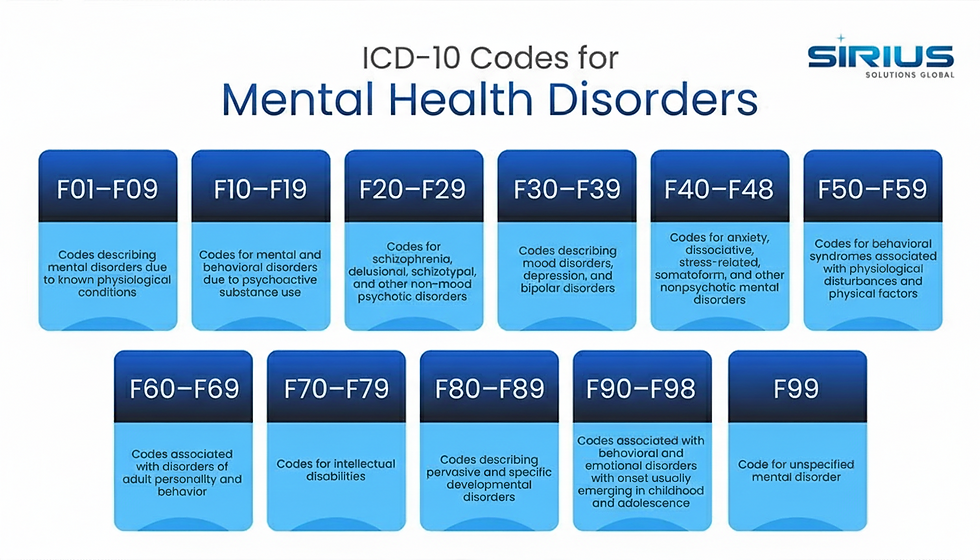
All behavioral health diagnoses fall under ICD-10 Chapter 5 (F01–F99). Think of this as a roadmap insurers use to evaluate care.
Here’s how payers mentally group them:
Cognitive and organic disorders
Substance use and addiction
Psychotic and schizophrenia spectrum disorders
Mood disorders like depression and bipolar
Anxiety, trauma, and stress-related conditions
Personality and developmental disorders
Childhood and adolescent behavioral diagnoses
The key rule insurers follow is simple:
If documentation supports specificity, the code must reflect it.
Unspecified codes are no longer neutral they are red flags.
The Mental Health ICD-10 Codes Used Most Often in 2026
Depression ICD-10 Codes (Where Most Denials Start)
Depression coding received extra attention in 2026 because payers want clearer justification for long-term and high-frequency therapy.
The most commonly accepted depression codes now include:
Major depressive disorder, single episode, mild
Major depressive disorder, single episode, moderate
Major depressive disorder, severe without psychotic features
Major depressive disorder, recurrent, moderate
Unspecified depression codes still exist, but insurers increasingly treat them as temporary placeholders, not long-term diagnoses.
👉 Search-driven insight:“ICD-10 code for major depressive disorder moderate” is now one of the most searched mental health billing queries in 2026.
Anxiety Disorder ICD-10 Codes That Get Approved Faster
Insurance companies want to know what type of anxiety they’re paying for not just that anxiety exists.
Codes that consistently perform better in claims processing include:
Generalized anxiety disorder
Panic disorder
Agoraphobia
Unspecified anxiety codes are one of the top causes of psychotherapy downcoding.
PTSD and Trauma-Related ICD-10 Codes
Trauma diagnoses are closely audited, especially when tied to crisis care or extended treatment plans.
What payers look for:
Clear identification of PTSD
Whether symptoms are acute or chronic
Chronic PTSD codes support ongoing therapy far better than unspecified trauma diagnoses.
Bipolar Disorder ICD-10 Coding (High Audit Risk Category)
Bipolar disorder claims are frequently reviewed because reimbursement levels vary significantly.
Insurers expect:
Clear distinction between Bipolar I and Bipolar II
Accurate episode documentation
Using unspecified bipolar codes increases the chance of chart requests.
ADHD and Neurodevelopmental Diagnoses
ADHD claims now require presentation type to justify behavioral therapy and follow-ups.
Codes that specify inattentive, hyperactive, or combined type are far more defensible than generalized ADHD diagnoses.
Substance Use Disorder Coding in 2026
Substance use billing hinges on severity levels.
Payers will not assume severity.If it’s not documented and coded, it doesn’t exist to them.
Always include:
Substance type
Severity (mild, moderate, severe)
This directly affects reimbursement eligibility.
What Actually Changed in ICD-10 for Mental Health in 2026
There were no dramatic new mental health categories added—but that’s exactly why denials increased.
Instead, CMS refined existing codes, especially for:
Depression severity
Episode specificity
Documentation expectations
Translation:The margin for vague coding disappeared.
Practices that didn’t adjust saw higher rejection rates. Practices that did saw smoother payments.

Real-World Best Practices That Reduce Mental Health Claim Denials
These aren’t theory they are patterns seen across high-performing behavioral health practices:
Document symptoms in plain clinical language
Match diagnosis severity to session length
Always include comorbid conditions when present
Avoid “unspecified” codes unless truly unavoidable
Review payer-specific diagnosis rules quarterly
Even small changes here can improve clean claim rates dramatically.
The Most Common ICD-10 Mental Health Denials (And Why They Happen)
If claims are being denied, it’s usually for one of four reasons:
Diagnosis doesn’t justify the CPT code
Severity not documented or coded
Comorbidities missing
Outdated ICD-10 code used
None of these mean the care wasn’t necessary.They mean the story wasn’t fully told in the coding.
Why Mental Health Practices Outsource ICD-10 Coding in 2026
Behavioral health coding has become too specialized for general billing teams.
Top-performing practices work with mental health–focused billing partners who:
Understand payer behavior
Track ICD-10 updates in real time
Reduce denials by 60–80%
Strengthen audit protection
Sirius Solutions Global leads in this space because their teams code specifically for behavioral health, not generic medical billing.
Final Thought: ICD-10 Coding Is a Revenue Strategy, Not Just Compliance
ICD-10 codes aren’t just numbers they are how insurers decide:
If your care is necessary
If your time is justified
If your practice gets paid fully
When mental health ICD-10 coding is done right, billing becomes predictable instead of stressful.