How to Choose a Neurology Billing Company in 2026: 10 Questions to Ask Before You Sign


A billing company's sales deck tends to hit the same notes: experienced coders, advanced technology, fast claim turnaround, better collections. All reasonable things to say. Then ask what the vendor would actually check first when an EMG/NCS claim comes back denied, and the conversation usually changes. Some vendors get specific — reason code, documentation, medical necessity, payer pattern. Others stay general, and that gap is the real signal.
Don't interview a neurology billing company with sales questions. Interview it with billing questions. A vendor can describe its services convincingly without ever showing you how it actually thinks through a denied claim, an underpayment, or a payer policy change — and that gap tends to show up later, in your A/R, not during the pitch.
This article walks through ten specific questions to ask before signing, a short stress test you can run live during a vendor call, and the practical details — pricing structure, onboarding, reporting — that separate a vendor that sounds right from one that actually understands neurology billing.
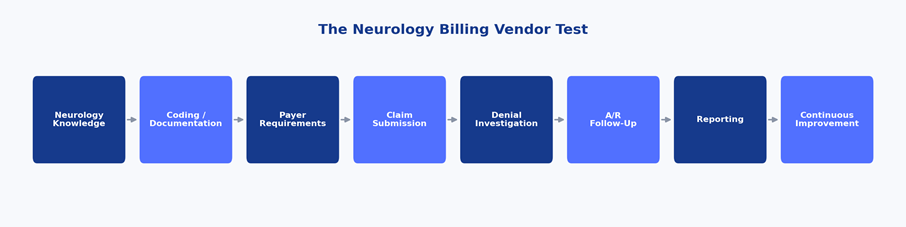
The Neurology Billing Vendor Test — a Sirius Solutions Global educational framework, not an official industry standard.
Why Neurology Billing Needs More Than General Medical Billing Knowledge
In short: neurology billing can involve E/M services, neurodiagnostic testing such as EEG and EMG/NCS, procedures, and sometimes injections or infusion services — each with its own documentation and medical-necessity expectations that general medical billing knowledge doesn't automatically cover.
Depending on the practice, that mix may include:
• Evaluation and management (E/M) visits, often with significant cognitive and time-based documentation
• EEG and EMG/NCS neurodiagnostic testing
• Procedures and, where applicable, injections or infusion services
• Prior authorization where applicable
• Medical-necessity documentation tied to specific diagnoses
• Specialty-specific payer and MAC policies
Not every neurology practice performs every one of these services. The point isn't that a vendor needs to know everything about neurology in the abstract — it's that the vendor needs to understand the specific services your practice actually bills, and be able to show it.
10 Questions to Ask Before You Sign a Neurology Billing Contract
Each question below includes what a strong answer should actually contain — not just what a vendor should say, but what should be behind the answer.
1. How much of your actual billing work is neurology?
A strong answer names the specific neurology services the vendor regularly bills — not just “we handle specialty billing.” Vague answers here are often a preview of vague answers everywhere else.
2. How do you handle neurology-specific coding and documentation?
Look for specific examples — how they handle E/M documentation requirements, or how they approach a neurodiagnostic claim — rather than a general statement about coding accuracy.
3. What is your process for EEG and EMG/NCS claims?
A credible answer touches medical necessity, documentation review, awareness that coverage and study-count rules can be MAC-specific, and a process for catching claim-edit issues before submission — not a universal rule, since EEG and EMG/NCS coverage criteria vary by Medicare Administrative Contractor and by payer.
4. What happens when a neurology claim is denied?
Denial → Reason Code Review → Root Cause → Correction → Resubmission / Appeal → Follow-Up → Trend Analysis → Prevention
“We appeal denials” is not a workflow. A vendor that can walk you through each of these steps — and explain how trend analysis feeds back into preventing the same denial next time — is operating at a different level than one that treats every denial as a one-off task.
5. How do you find underpayments?
A strong answer discusses comparing expected reimbursement against the allowed amount, reviewing payment posting for variance, and watching for payer-level patterns — not a guarantee that every underpayment is recoverable, since recoverability depends on contract terms and payer policy.
6. How do you manage A/R?
Ask about aging-bucket prioritization, how high-dollar accounts are flagged, what happens to claims aging past 90 days, the follow-up cadence, and when an account gets escalated internally.
7. What reporting will my practice receive?
Expect detail on collections, denials, A/R aging, payer performance, claim status, appeal outcomes, and — where relevant to a multi-provider group — provider-level data.
8. How do you handle changes in payer policies?
Look for an actual monitoring process, a way staff get notified of a relevant change, and how documentation or workflow gets updated once a policy shifts — not just “we stay current.”
9. What exactly am I paying for?
Ask whether the fee is percentage-based, flat, or hybrid, and what's included versus billed separately — coding, clearinghouse or software fees, setup/onboarding, credentialing, or additional follow-up work. There's no single reliable “industry standard” percentage to compare against; the structure matters more than the headline number.
10. What happens during the first 90 days?
A credible answer includes a transition plan, a review of your existing data, workflow mapping, a KPI baseline, an early denial review, and a defined reporting and communication schedule — not just “we'll get you set up.”
Choosing an RCM partner should start with better questions. Sirius Solutions Global is glad to walk through how we'd answer each of these ten questions for your practice. |
The 5-Minute Neurology Billing Vendor Stress Test
Here's a hypothetical scenario you can run live on a vendor call: a neurology patient receives an E/M service and neurodiagnostic testing in the same visit. The claim comes back denied. Ask the vendor: “What would you check first?”
A vendor working through this well will touch most of the following — not necessarily in this exact order, since the right sequence can vary by denial reason:
☐ Provider/payer enrollment
☐ Eligibility
☐ Authorization, if applicable
☐ Documentation
☐ Medical necessity
☐ Coding
☐ Modifiers, where applicable
☐ Payer/MAC coverage policy
☐ Claim construction
☐ Denial reason
☐ A/R history
Educational stress test — not a universal denial workflow. The exact order can and should vary by the specific denial.
What a Strong Neurology Billing Company Should Know About EEG and EMG/NCS
Current CMS Medicare Coverage Database materials — including Local Coverage Determinations and their associated Billing and Coding Articles for nerve conduction studies and electromyography — show that these services can carry specific coverage and medical-necessity requirements that vary by Medicare Administrative Contractor. Some MACs, for example, apply their own maximum study-count guidance and specific covered-diagnosis lists within their coverage articles.
A vendor doesn't need to recite every MAC's policy from memory. What matters is whether the vendor knows how to verify current coverage guidance for the plans your practice actually bills, review documentation against that guidance, recognize when a claim is missing medical-necessity support, and catch an unsupported submission before it goes out — rather than finding out about a coverage gap only after a denial arrives.
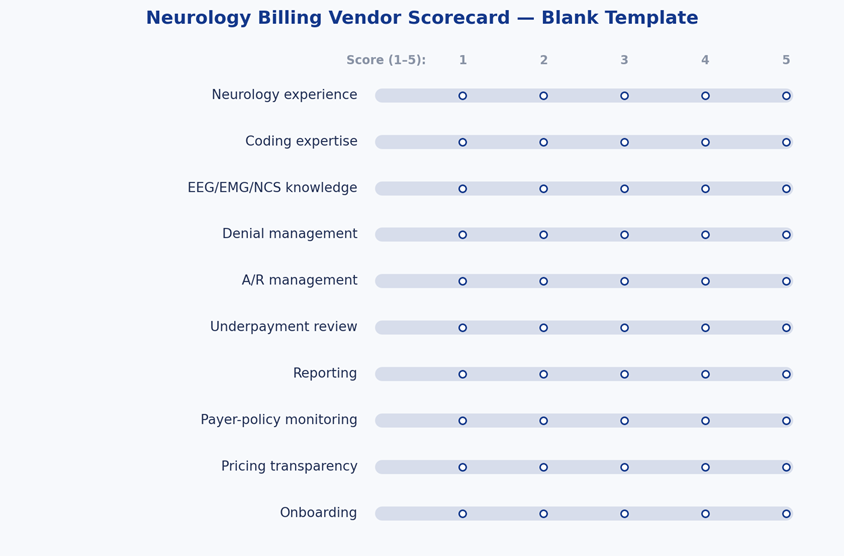
Neurology Billing Vendor Scorecard — a blank, reusable template. Fill it in during or after each vendor call.
Denial Management Is More Than Sending Appeals
The Neurology Denial Loop: Claim → Denial → Reason → Root Cause → Action → Resolution → Trend → Prevention
A strong billing partner uses denials as a feedback loop, not just a to-do list. If the same denial reason keeps showing up across multiple claims, that's a signal to fix something upstream — a documentation template, a coding habit, a prior-authorization step — rather than appealing the same issue every month without ever closing the loop.
What Should Your Neurology RCM Dashboard Show?
Metric | What It Tells You |
Net collections / collection performance | How much of what's owed is actually being collected |
Denial rate | How often claims are rejected on first submission |
Clean claim rate | How many claims go out correctly the first time |
Days in A/R | How long it typically takes to collect |
A/R over 90 days | How much aging balance may need focused attention |
Underpayments | Whether payments match contracted or expected amounts |
Payer denial trends | Whether specific payers need a different approach |
Appeal outcomes | Whether appeals are actually succeeding |
Claim aging | Where claims sit in the submission-to-payment timeline |
Provider-level trends | Useful for multi-provider groups to spot provider-specific patterns |
No single number on this dashboard guarantees a healthy practice on its own — these metrics are meant to be reviewed together, not in isolation.
What Should You Ask About Pricing?
The lowest percentage fee isn't automatically the lowest total cost. Before comparing vendors on price alone, ask what's actually included:
• What services are included in the base fee, and what's billed separately
• Setup or onboarding fees
• Coding fees, if coding is handled separately from billing
• Clearinghouse or software fees
• Credentialing fees, if applicable
• Additional charges for follow-up work, like appeals or extended A/R work
• Contract term and termination provisions
A lower headline percentage attached to a long list of add-on fees can end up costing more than a higher, all-inclusive rate. There's no single reliable industry-standard percentage to benchmark against — the fee structure and what it actually covers matter more than the number itself.
What Should Happen During the First 90 Days?
This is a Sirius Solutions Global educational onboarding framework, not a universal industry timetable — actual onboarding will vary by vendor and practice.
Days 1–30: Access setup, data review, workflow mapping, payer review, A/R baseline
Days 31–60: Process corrections, denial analysis, reporting setup, staff communication
Days 61–90: Trend review, KPI comparison against the baseline, workflow refinement, priority-setting for the next phase
Neurology Billing Vendor Scorecard
Score each vendor you're evaluating from 1 to 5 on each category below (the blank template above can be printed or copied for this):
• Neurology experience (1–5)
• Coding expertise (1–5)
• EEG/EMG/NCS knowledge (1–5)
• Denial management (1–5)
• A/R management (1–5)
• Underpayment review (1–5)
• Reporting (1–5)
• Payer-policy monitoring (1–5)
• Pricing transparency (1–5)
• Onboarding (1–5)
Maximum score: 50 points.
• 40–50 — Strong candidate for deeper due diligence
• 30–39 — Several areas require clarification
• Below 30 — Additional due diligence recommended
Educational evaluation framework — not an industry certification.
You don't need another billing report. You need to know what the numbers are telling you. Sirius Solutions Global can walk through your current RCM reporting and help identify what's missing. |
60-Second Neurology RCM Readiness Check
☐ We can see our denial trends
☐ We know our A/R over 90 days
☐ We monitor payer performance
☐ We review underpayments
☐ Our billing team understands our major neurology services
☐ We can identify who owns denied claims
☐ Our vendor explains why claims are denied
☐ We receive actionable monthly reporting
☐ We understand our vendor's pricing
☐ We have a documented onboarding / transition process
Count your checks:
• 0–3 checked — Your billing visibility may need attention.
• 4–7 checked — Several controls are present, but gaps may remain.
• 8–10 checked — You have a stronger RCM visibility foundation.
Educational RCM self-check — not a financial audit or billing certification.
Is Your Billing Company Giving You Answers — or Just Reports?
A report tells you what happened. A stronger RCM relationship should also help explain why it happened, where it started, and what should happen next. If your current monthly report shows a denial rate without explaining the leading reason codes, or shows A/R aging without a plan for the accounts past 90 days, you're getting data — not insight. That distinction is worth testing with any vendor before you sign, and worth revisiting with your current vendor if you haven't asked lately.
How Sirius Solutions Global Supports Neurology Billing
Sirius Solutions Global works with healthcare practices across medical billing, revenue cycle management, claims management, denial management, A/R follow-up, payment posting, eligibility and insurance verification support, billing workflow review, and RCM reporting.
We won't tell you we're objectively “the best” — that's a judgment every practice should make through its own due diligence, using questions like the ones in this article. We also won't promise a specific collection increase, guaranteed reimbursement, or zero denials; neurology billing outcomes depend on documentation, payer policy, and circumstances specific to each practice and claim.
The Takeaway
The right billing company shouldn't simply tell you what happened to your claims. It should be able to explain what happened, where the problem began, what should happen next, and how the workflow can improve so it doesn't keep happening. That's a different standard than a confident sales presentation, and it's the one worth holding every vendor to — including us.
Frequently Asked Questions
Q: How do I choose a neurology billing company?
Evaluate vendors on specific neurology experience, how they investigate denials and underpayments, what reporting they provide, how transparent their pricing is, and what their onboarding process looks like — rather than relying on general claims about expertise.
Q: What should I look for in a neurology billing company?
Look for a vendor that can give specific, concrete answers about your actual services — E/M, EEG, EMG/NCS, procedures — and that can walk through a real denial or underpayment scenario rather than offering general reassurances.
Q: Why does neurology billing require specialty-specific knowledge?
Neurology practices may bill a mix of E/M, neurodiagnostic testing, and procedures, each with its own documentation and medical-necessity expectations that general medical billing knowledge doesn't automatically cover.
Q: What should a neurology billing company know about EEG and EMG/NCS?
They should know how to verify current MAC-specific and payer-specific coverage and medical-necessity guidance, review documentation against that guidance, and catch unsupported claims before submission — coverage requirements for these services can vary by Medicare Administrative Contractor.
Q: How should a neurology billing company handle denials?
A strong process moves from reason-code review to root-cause analysis to correction, resubmission or appeal, follow-up, and trend analysis that feeds back into preventing the same denial in the future — not just filing an appeal and moving on.
Q: What should neurology billing reports include?
Collections, denial rates, A/R aging, payer performance trends, claim status, appeal outcomes, and — for multi-provider groups — provider-level data.
Q: What should I ask about billing company pricing?
Ask what's included in the base fee versus billed separately — coding, clearinghouse or software fees, setup costs, credentialing, and additional follow-up charges — along with the contract term and termination provisions.
Q: What should happen during the first 90 days with a new billing company?
A credible onboarding plan typically includes data access and review, workflow mapping, a KPI baseline, an early denial review, reporting setup, and a defined communication schedule.
Disclaimer: Neurology coding, billing, payer policies, coverage requirements, medical-necessity standards, and reimbursement rules can vary by payer, Medicare Administrative Contractor, provider, service, diagnosis, contract, and individual circumstances. This article is provided for general educational purposes and should not be treated as payer-specific coding, billing, legal, or compliance advice. Practices should verify current CMS, MAC, payer, and CPT guidance before implementing billing changes.