

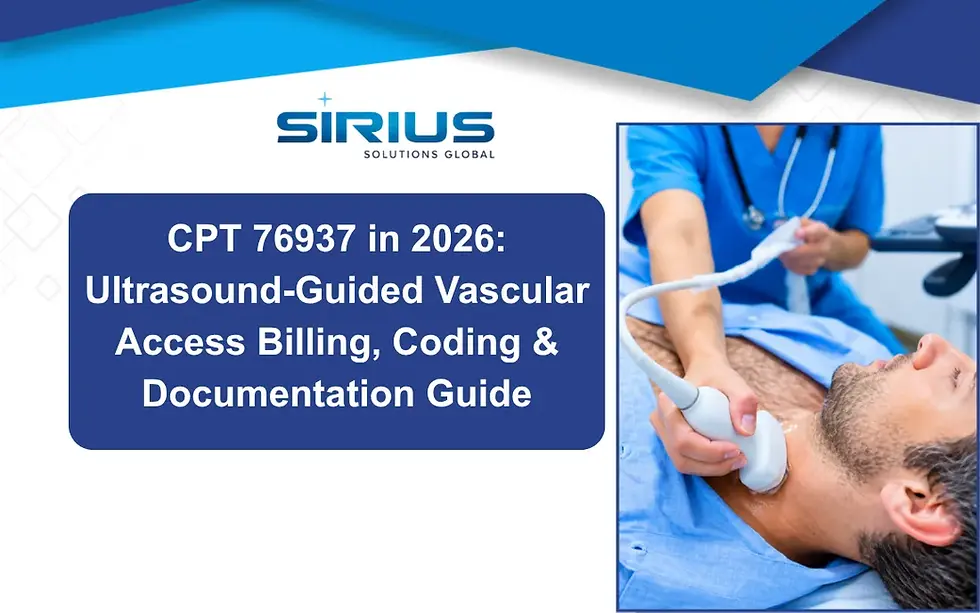
CPT 76937 in 2026: Ultrasound-Guided Vascular Access Billing, Coding & Documentation Guide

In this guide
1. Why CPT 76937 Documentation Matters
“Ultrasound guidance was used” is not documentation — it is a summary that hides exactly the details a payer will ask for. CPT 76937 does not reward a single sentence confirming that a probe was in the room. It rewards four specific, independently verifiable findings in the chart.
Billing teams that treat 76937 as a reflexive add-on, rather than a code with its own evidentiary bar, are usually the ones who see it stripped on review. This guide covers what the code actually requires, how it differs from CPT 76942, where Medicare's National Correct Coding Initiative (NCCI) policy currently stands for 2026, and the habits that keep a clean claim clean.
2. What Is CPT 76937?
CPT 76937 (Ultrasonic guidance for vascular access requiring ultrasound evaluation of potential access sites, documentation of selected vessel patency, concurrent real-time ultrasound visualization of vascular needle entry, with permanent recording and reporting) describes ultrasound guidance used specifically to gain vascular access — not a general diagnostic ultrasound, and not ultrasound used elsewhere in a procedure.
It is an add-on code (+76937): reported together with, and only with, an eligible primary procedure that enters a vessel. It is never billed as a standalone line. The code exists because image-guided vascular access carries a distinct clinical workflow compared with a landmark (palpation-only) technique — but that workflow only becomes a billable service when the record demonstrates it.
3. Four Documentation Requirements for CPT 76937
CPT 76937's descriptor bundles four elements into one code. All four need chart support; a record missing even one does not meet the requirement — regardless of how the rest of the note reads.
1. Ultrasound evaluation of potential access sites
Before the needle goes in, the sonographer or proceduralist should document that candidate sites were actually assessed — not just that one vessel was ultimately chosen.
2. Documentation of selected vessel patency
The note needs to identify which vessel was selected and state that it was patent (open, compressible, with appropriate flow) at the time of access.
3. Concurrent real-time visualization of vascular needle entry
This is the element most often missed. The ultrasound must be actively visualizing the needle as it enters the vessel — not simply used beforehand to mark a skin entry point.
4. Permanent recording and reporting
A retained image (or clip) belongs in the patient record, along with a written description of the ultrasound-guided access either in the procedure note or as a separate report.
Documentation checkpoint table
Documentation element | What the record should establish | Common documentation gap |
Site evaluation | Assessment of potential access sites | No evaluation documented |
Vessel patency | Selected vessel identified and confirmed patent | Patency not recorded |
Real-time visualization | Ultrasound visualization during needle entry itself | Only a static site image is present |
Permanent recording | Retained image/clip plus a procedure description | No image retained, or no written description |
Hypothetical documentation example (illustrative only — not an actual patient record):
“Right internal jugular vein evaluated by ultrasound; confirmed patent with normal compressibility and color flow. Left IJ not selected due to overlying soft-tissue swelling. Vein accessed under continuous real-time ultrasound visualization of needle entry into the lumen. Representative image archived to PACS.”
4. Dynamic vs. Static Ultrasound Guidance
This distinction decides whether 76937 is reportable at all. Dynamic guidance means the ultrasound is actively visualizing the needle as it advances into the vessel. Static guidance means ultrasound was used only to locate or mark the vessel beforehand, with the actual needle pass performed by feel.
CPT 76937 requires the dynamic technique. A note that documents a pre-procedure scan and a separately performed “landmark” puncture — however well that scan is documented — does not meet the real-time needle-entry requirement. The code does not require continuous ultrasound for the entire vascular access encounter, only concurrent visualization of the actual needle-entry moment.
| Dynamic (meets 76937) | Static (does not meet 76937) |
Timing of ultrasound use | During needle advancement into the vessel | Before needle entry only |
What is visualized | The needle tip entering the lumen in real time | Vessel location/landmark, then access by feel |
Typical phrasing to watch for | “Accessed under real-time/continuous ultrasound visualization” | “Site marked by ultrasound” / “Ultrasound used to locate vessel” |
5. CPT 76937 vs. CPT 76942
The two codes are not interchangeable, and CPT guidance directs coders to choose based on the actual procedure, not the imaging modality alone. CPT 76937 is specific to ultrasound guidance for vascular access. CPT 76942 (Ultrasonic guidance for needle placement) covers other needle-placement procedures such as biopsy, aspiration, injection, or placement of a localization device.
When ultrasound is used to guide a needle into a vessel, 76937 is the applicable code — not 76942. The two should not be reported together for the same guidance event.
Coding consideration | CPT 76937 | CPT 76942 |
Primary purpose | Ultrasound-guided vascular access | Ultrasound-guided needle placement |
Procedure context | Vascular needle entry | Biopsy, aspiration, injection, localization device, and similar |
Documentation focus | Site evaluation, vessel patency, real-time entry visualization, permanent record | Guidance and imaging documentation appropriate to the procedure performed |
Reporting status | Add-on code (+76937) | Follow the applicable CPT reporting instructions for the primary procedure |
6. CPT 76937 as an Add-On Code
Because 76937 is an add-on code, it is reported only with an eligible primary procedure — never alone. Billing teams should verify the parenthetical instructions under the primary code being billed, since CPT identifies which services 76937 may accompany and which ones already include ultrasound guidance in their own descriptor.
Add-on code status also does not guarantee separate payment. Current Medicare add-on code edits and individual payer policies still govern whether a given pairing is separately reportable, so the primary code's own instructions and the current quarterly edit files should be checked before the claim goes out — not assumed from memory or a prior year's rule.
7. Medicare NCCI Restrictions and Bundling Rules
Compliance reminder: this policy area has changed CMS's Chapter 9 (Radiology) General Policy Statements once grouped CPT 76937 with other ultrasound-guidance codes as not separately reportable — language some cardiology and interventional references read as a blanket bundling of 76937 into cardiac catheterization, PCI, pacemaker, and electrophysiology procedures. That language was removed effective February 14, 2024, to align with CPT's own instructions. The current Medicare NCCI Policy Manual (revision date 1/1/2026) no longer names 76937 in that general policy statement — only CPT 76942 and 76998 remain listed there. There is therefore no current universal NCCI rule barring 76937 from every cardiac or vascular procedure. That does not make every pairing automatically payable: individual NCCI procedure-to-procedure (PTP) edits, the primary code's own CPT instructions, and payer policy can still make guidance non-separately-reportable for a specific pairing. Check the current quarterly PTP edit file and the primary code's descriptor — not an older blanket assumption — before billing 76937 with a cardiac catheterization, PCI, device implant, or electrophysiology procedure. |
Where an edit does exist and a modifier (59, XE, XP, XS, or XU) might apply, it should only be appended when the documentation supports a genuinely separate and distinct service — never solely to bypass an edit.

8. Common CPT 76937 Billing and Documentation Mistakes
Common mistake | Why it matters | Recommended review |
Missing vessel patency statement | A required documentation element is incomplete | Review the procedure note for patency language |
No real-time needle-entry visualization documented | Does not establish the required dynamic guidance | Confirm wording reflects concurrent visualization |
No permanent image or clip retained | The required permanent record is missing | Check the image archive / PACS |
Static ultrasound only (site marked, not watched during entry) | Does not meet the full reporting requirement | Review the actual technique described |
76937 reported without an eligible primary procedure | Add-on codes cannot stand alone on a claim | Validate the primary procedure code |
76937 and 76942 reported for the same guidance event | The codes describe different services and are not interchangeable here | Confirm which code matches the procedure performed |
Separate reporting where a current NCCI edit applies | May conflict with Medicare correct-coding rules | Review the current quarterly PTP edit file |
9. Medicare Reimbursement and Commercial Payer Considerations
The CY 2026 Medicare Physician Fee Schedule sets RVUs and a conversion factor that change the dollar amount tied to any CPT code, including 76937. Professional, technical, facility, and non-facility payment can differ for the same code, and geographic practice cost indices adjust payment by locality.
No single reimbursement figure for 76937 is accurate everywhere. Verify current payment using the CMS Physician Fee Schedule Look-Up Tool for the applicable locality, site of service, and effective quarter rather than a figure carried over from a prior year.
Commercial payers add another layer: contracted rates, prior authorization rules, and payer-specific bundling edits may diverge from Medicare NCCI policy. Correct coding establishes what may be billed — it does not guarantee payment, which stays subject to medical necessity review and the terms of the specific payer contract.
10. CPT 76937 Claim Review Checklist
Use this as a pre-submission checklist for any claim carrying CPT 76937:
☐ Vascular access was actually performed
☐ Potential access-site evaluation is documented
☐ Selected vessel patency is documented
☐ Real-time needle-entry visualization is documented (not just site marking)
☐ A permanent ultrasound image or clip is retained in the record
☐ The procedure report describes the ultrasound-guided access
☐ An eligible primary procedure code is present on the claim
☐ Current add-on code edits for the primary/76937 pairing have been checked
☐ Current NCCI PTP edits and payer-specific bundling rules have been reviewed
☐ The claim is accurate and documentation-supported before submission
11. How Structured Billing Workflows Support Vascular Practices
Coding accuracy for a code like 76937 rarely comes down to one coder's judgment call — it depends on a workflow that catches documentation gaps before a claim is filed: a documentation review step, a current reference for NCCI PTP and add-on edits, denial tracking that flags recurring 76937 issues by primary code, and A/R follow-up that distinguishes documentation denials from bundling denials.
That is the kind of structured revenue cycle management work Sirius Solutions Global supports for vascular surgery, interventional radiology, emergency medicine, and cardiology practices — built around current coding guidance rather than rules that may be several update cycles old.
Is Your Vascular Access Billing Workflow Documentation-Ready? If your team is unsure whether current 76937 claims would hold up under a documentation audit, a structured review can surface gaps before a payer does. |
12. Frequently Asked Questions
Q: What is CPT code 76937 used for?
A: It reports ultrasound guidance specifically for vascular access — evaluating potential sites, confirming vessel patency, visualizing needle entry in real time, and retaining a permanent image with a description of the process.
Q: What documentation is required for CPT 76937?
A: All four elements: site evaluation, vessel patency, real-time needle-entry visualization, and a permanent recorded image plus description. Missing any one does not meet the requirement.
Q: Does CPT 76937 require real-time ultrasound visualization?
A: Yes. The ultrasound must visualize the needle entering the vessel as it happens — not just locate or mark the vessel beforehand.
Q: Is CPT 76937 an add-on code?
A: Yes. It is reported only with an eligible primary vascular access procedure and is never billed as a standalone line.
Q: What is the difference between CPT 76937 and 76942?
A: 76937 applies to ultrasound guidance for vascular access specifically. 76942 applies to ultrasound guidance for other needle-placement procedures, such as biopsy or injection. They describe different services and should not be reported together for the same guidance event.
Q: Can CPT 76937 be billed with every central venous catheter procedure?
A: No. Some vascular access procedure descriptors already include imaging guidance, which means 76937 adds nothing for those codes. Always check the primary code's own CPT instructions and current payer edits.
Q: Does static ultrasound guidance qualify for CPT 76937 reporting?
A: No. If ultrasound was used only to identify or mark the vessel before a non-guided puncture, the real-time needle-entry requirement is not met and 76937 should not be reported.
Disclaimer
This article is intended for educational and informational purposes only. CPT coding instructions, Medicare payment policies, payer coverage requirements, and applicable billing guidance may change. Healthcare providers and billing professionals should consult current official CPT materials, CMS guidance, applicable payer policies, and qualified coding professionals before submitting claims. This content does not constitute legal, medical, or reimbursement advice.


