

CPT Codes 36011 and 36012: Venous Catheterization Coding Guidelines, Billing, Documentation, and Reimbursement (2026 Guide)


Table of Contents
● What Is Selective Venous Catheterization?
● CPT 36011 vs. CPT 36012: Understanding the Difference
● Venous Catheterization Coding Guidelines
● Documentation Requirements
● Relationship to Other Procedures
● Common Billing Mistakes
● Medicare Reimbursement in 2026
● Practical Claim Review Example
● Pre-Submission Checklist
● FAQ, Disclaimer, and References
A catheter advances from the vena cava into the right renal vein, then further into the right adrenal vein. Two branch orders, two codes available — but the correct claim reports only one of them for this vascular family, coded to the highest level of selectivity actually reached. Reporting both 36011 and 36012 for that same family isn't a more complete claim; it's a coding error.
CPT 36011 and 36012 report selective venous catheter placement — first-order and second-order-or-more-selective branches, respectively. Billing them correctly depends on tracing the documented catheter route, identifying the vascular family and branch order actually reached, and knowing when a second code applies to a distinct family rather than the same one. This guide covers both codes' requirements, 2026 Medicare reimbursement, and the errors that most often complicate interventional radiology and vascular claims.
What Is Selective Venous Catheterization?
Venous catheterization involves advancing a catheter into the venous system to perform diagnostic imaging, blood sampling, or a therapeutic intervention. Nonselective placement means the catheter tip remains in the superior or inferior vena cava (reported with CPT 36010); selective catheterization means the catheter is deliberately advanced beyond the vena cava into a specific venous branch to reach a target vessel.
Physicians select specific venous branches for reasons that vary by procedure — sampling blood from a specific gland's draining vein (such as adrenal vein sampling for hormone-producing tumors), accessing a vessel for embolization, or navigating toward a target for a therapeutic intervention. Common examples include catheterizing the renal vein to reach it directly (first-order), then advancing further into the adrenal vein (second-order); or accessing the internal jugular vein and advancing into the inferior petrosal sinus for specialized sampling procedures.
CPT 36011 vs. CPT 36012: Understanding the Difference
Comparison | CPT 36011 | CPT 36012 |
Code description | Selective catheter placement, venous system; first order branch | Selective catheter placement, venous system; second order, or more selective, branch |
Reporting concept | Catheter advanced from the vena cava into the first branch vessel off that trunk | Catheter advanced beyond the first-order branch into a more distal, more selective vessel |
Anatomical examples | Renal vein, hepatic vein, internal jugular vein (accessed directly) | Left adrenal vein (via renal vein), inferior petrosal sinus (via jugular vein) |
Documentation focus | Confirm the catheter left the vena cava and entered a named first branch | Confirm the catheter was advanced further into a named, more distal branch of that same family |
Coding consideration | Code to the highest order of selectivity actually reached for that vascular family — if the catheter stops here, only 36011 applies | Used instead of, not in addition to, 36011 for the same vascular family once second-order selectivity is reached |
The key coding principle, confirmed by recognized interventional radiology coding references: code to the highest order of selectivity reached within a given vascular family, and report each distinct vascular family selected separately. If the catheter advances from the renal vein into the adrenal vein during the same family's workup, that family is reported once — with 36012, not both 36011 and 36012 together. If the physician also separately catheterizes an unrelated vascular family (for example, the opposite kidney's venous system or a distinct territory), that second family may be separately reported to its own highest order reached, which can mean reporting 36012 more than once in a single session when multiple distinct families each reach second-order-or-beyond selectivity.
As a clearly hypothetical, educational example only: a catheter is introduced into the inferior vena cava, advanced into the right renal vein (first order), then further into the right adrenal vein (second order) for selective sampling. Because this is one vascular family coded to its highest level reached, the correct report is CPT 36012 alone — not 36011 plus 36012. This illustration does not represent an actual patient record or guaranteed coding outcome.
Venous Catheterization Coding Guidelines

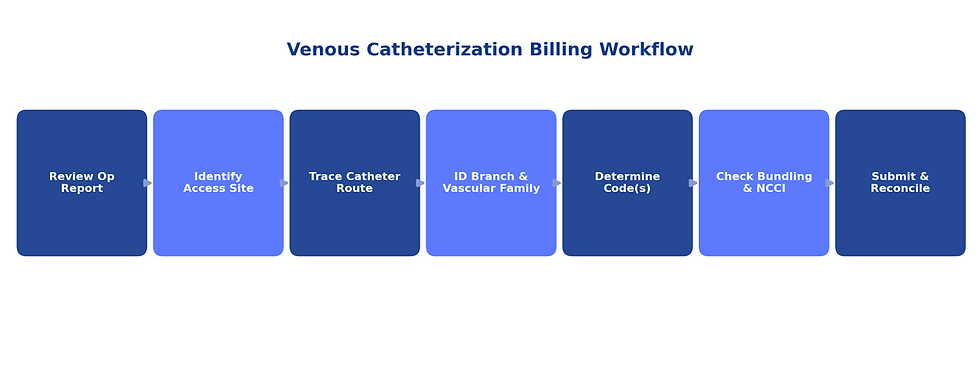
● Identify the vascular access site documented in the operative report
● Trace the documented catheterization route from access point to final position
● Distinguish nonselective placement (36010) from selective placement (36011/36012)
● Determine the branch order actually reached for each distinct vascular family
● Confirm the catheter manipulation described — not just the final resting position — supports the billed level of selectivity
● Identify whether multiple distinct vascular families were separately catheterized
● Review whether catheter placement is included in a more comprehensive primary or therapeutic procedure
● Check applicable NCCI edits before finalizing the claim
● Confirm current payer-specific policies, which can vary from Medicare's general approach
CPT 36011 and 36012 Documentation Requirements
Documentation Checkpoint | What to Verify | Why It Matters |
Clinical indication | Medical necessity for selective venous access documented | Supports coverage |
Original access site | Site of initial venous entry recorded | Establishes the starting point for branch-order counting |
Catheter route | Named vessels the catheter was advanced through, in order | Confirms actual branch order reached, not just the endpoint |
Vascular family | Each distinct family catheterized is identified separately | Determines whether multiple codes are appropriate |
Diagnostic/therapeutic purpose | Reason for the selective access documented | Links the service to the broader procedure |
Relationship to other procedures | Whether catheterization supported embolization, sampling, or another intervention | Determines if it's separately reportable or included |
The record must establish the actual catheter manipulation performed, not simply the final catheter location — a note describing only where the catheter ended up, without the route taken, does not reliably support a specific branch-order code.
Relationship Between Venous Catheterization and Other Procedures
CPT 36005 is specifically defined as the injection procedure for extremity venography — it is not a general-purpose venous catheterization code and should not be used to report catheter placement outside that specific context. CPT 36010 (nonselective vena cava catheter introduction) is generally bundled into the more selective code (36011 or 36012) when the catheter is subsequently advanced into a branch during the same encounter; only the code matching the final documented level of selectivity is reported.
Whether 36011/36012 is separately reportable alongside a therapeutic procedure — such as embolization, a central venous device placement, or a dialysis access intervention — depends on the specific procedure's own coding instructions. Some comprehensive codes explicitly include selective catheterization of central vessels as part of their own descriptor, in which case 36011/36012 would not be separately reportable for that same central access; but they may still apply when a physician separately catheterizes an unrelated accessory vessel, such as for coiling or to assess contralateral vessel patency. Confirm the specific primary procedure's instructions and current NCCI edits before reporting catheterization separately.
Common CPT 36011 and 36012 Billing Mistakes
Common Mistake | Preventive Review Step |
Confusing first-order and second-order branches | Trace the documented route vessel by vessel from the access site |
Coding based only on the catheter's final position | Confirm the route, not just the endpoint, supports the billed order |
Reporting 36011 and 36012 together for the same vascular family | Code only to the highest order reached per family |
Confusing selective catheterization with venography | Separate catheter placement (36011/36012) from contrast injection/imaging work |
Misusing CPT 36005 | Confirm 36005 is reserved for extremity venography injection only |
Separately reporting catheterization already included in another procedure | Check the primary procedure's own coding instructions first |
Applying arterial catheterization hierarchy logic to venous procedures | Venous and arterial selective catheterization rules are not identical — verify venous-specific guidance |
Overlooking applicable NCCI edits | Run current edits before submission, not from memory of a prior year |
Ignoring payer-specific requirements | Confirm the applicable payer's documentation and coverage policy |
Not every coding issue results in a denial — the next step depends on the documentation, current coding rules, and the payer's specific response.
Accurate venous catheterization billing requires a clear understanding of procedural documentation, vessel selection, coding guidelines, and payer requirements. A structured revenue cycle workflow can help healthcare organizations identify billing issues before claims are submitted. Explore Medical Billing Solutions with Sirius Solutions Global.
Medicare Reimbursement for CPT 36011 and 36012 in 2026
Both codes are paid under Medicare's Physician Fee Schedule for the professional component, using the standard RVU-based formula: (work RVU + practice expense RVU + malpractice RVU), adjusted by the locality's Geographic Practice Cost Indices, multiplied by the CY2026 conversion factor ($33.4009 standard, $33.5675 for qualifying Advanced APM participants). Payment differs between facility and non-facility settings because the practice expense component shifts depending on who bears the overhead cost.
We found inconsistent reimbursement figures for these specific codes across available secondary sources at the time of writing, with notably conflicting total RVU figures reported for CPT 36012. Rather than publish a potentially incorrect dollar amount, we recommend looking up the current, locality-adjusted rate directly using CMS's Physician Fee Schedule Lookup Tool. For hospital outpatient or ASC facility reimbursement (distinct from the physician's professional payment), consult the applicable OPPS or ASC payment files rather than the Physician Fee Schedule.
Term | What It Means |
Billed charge | The amount the provider submits on the claim |
PFS allowed amount (professional) | The Medicare-recognized rate for the physician's work, locality-adjusted |
Facility payment (OPPS/ASC) | Determined separately from the physician's professional payment |
Commercial payer payment | Set by the individual payer's contract, which can differ meaningfully |
Patient responsibility | Any deductible, coinsurance, or non-covered amount, where applicable |
Practical Venous Catheterization Claim Review Example
As a hypothetical, educational scenario only: an interventional radiologist accesses the right common femoral vein, advances a catheter into the inferior vena cava, then selectively into the left renal vein (first order), and further into the left adrenal vein (second order) for selective venous sampling. In the same session, the physician also separately catheterizes the right adrenal vein via the right renal vein for comparison sampling — a second, distinct vascular family reaching the same second-order level.
Based on this documented route, the billing team would review: the access site (femoral vein), the full catheter path for each side, confirmation that each side represents a distinct vascular family, and that each family reached second-order selectivity. The coding question becomes whether CPT 36012 should be reported twice — once for each distinct adrenal vein family — subject to current payer policy and documentation support, rather than reporting 36011 at all for either side, since both reached second-order selectivity. This example is illustrative only, not a real client case, real reimbursement amount, or guaranteed coding outcome.
Pre-Submission Venous Catheterization Billing Checklist
☐ | Correct access site identified |
☐ | Catheterization route reviewed vessel by vessel |
☐ | Selected venous branches and families documented |
☐ | First-order versus second-order classification reviewed |
☐ | Correct CPT code(s) selected for each distinct vascular family |
☐ | Medical necessity supported by the clinical indication |
☐ | Operative/procedure report reviewed in full |
☐ | Related and primary procedure codes evaluated for bundling |
☐ | Current NCCI edits checked |
☐ | Payer-specific policies verified |
☐ | Claim information reviewed before submission |
A structured pre-submission review like this helps catch branch-order misclassification and bundling issues before a claim goes out — this is an educational workflow aid, not an official coding approval or compliance determination.
Frequently Asked Questions
(Displayed as expandable accordion sections on the published web version.)
What is CPT code 36011 used for?
Reporting selective catheter placement into a first-order venous branch off the vena cava, such as the renal or hepatic vein.
What is CPT code 36012 used for?
Reporting selective catheter placement into a second-order or more distal venous branch, such as the adrenal vein reached via the renal vein.
What is the difference between first-order and second-order venous catheterization?
First-order means the catheter was advanced directly from the vena cava into one branch vessel; second-order (or more selective) means it was advanced further into a branch of that first branch.
Can CPT 36011 and 36012 be reported together?
Generally not for the same vascular family — code to the highest order of selectivity reached for that family. Both codes may apply in the same session only when distinct vascular families are separately catheterized.
Is CPT 36012 an add-on code?
Confirm this against the current official CPT code set before relying on any secondary summary; available references we reviewed describe it as independently reportable (not formatted as a traditional “+” add-on code), but it is used once per qualifying vascular family rather than stacked with 36011 for the same family.
What documentation supports selective venous catheterization billing?
A documented access site, the named vessels the catheter was advanced through in sequence, the vascular family and branch order reached, and the diagnostic or therapeutic purpose of the catheterization.
What is the difference between venous catheterization and venography?
Catheterization describes placing and advancing the catheter itself; venography describes the contrast injection and imaging performed, which may use codes like 36005 for extremity venography. They are distinct components of a procedure, not interchangeable terms.
Disclaimer
This article is for general educational purposes and does not replace the current CPT code set, official CMS and NCCI guidance, applicable payer policies, or professional coding advice. Verify 36012's current add-on code status and the specific branch-order classification of any vessel against the current official CPT codebook before applying it to a claim. Coding and billing decisions for a specific claim should be verified against official sources and payer requirements in effect at the time of service. Reimbursement information in this article reflects general Physician Fee Schedule methodology as of October 2026; confirm exact current payment amounts directly using CMS's Physician Fee Schedule Lookup Tool before relying on them for billing decisions.
Strengthen Your Interventional Billing Workflow
Accurate CPT 36011 and 36012 reporting comes down to tracing the documented catheter route, correctly identifying each distinct vascular family and the highest order of selectivity reached, and checking current bundling rules before the claim goes out — not simply coding to wherever the catheter ended up.
Looking to strengthen your medical billing and coding operations? Sirius Solutions Global helps healthcare organizations manage billing workflows, coding processes, claims, and revenue cycle operations.


