

Best Anesthesia Billing Companies in California 2026: Top 10 RCM Providers for Anesthesia Practices


A 94-minute case ends, and the record shows a start time but no clear end time. The claim sits in a work queue while the group waits on a signature. Multiply that by hundreds of cases and you see why anesthesia billing is its own discipline: time-based units, base units, modifiers tied to medical direction, concurrency rules, and payer policies that rarely match.
California adds its own wrinkles, including Medi-Cal rules and out-of-network protections under AB 72. This guide compares 10 billing and RCM companies using only what they publish, explains the specialty-specific challenges, and gives you tools to evaluate any partner. This is not a ranking or an award list.
How we compared We reviewed each company’s own website and noted anesthesia-specific content, California evidence, and services. We did not verify results, pricing, or client claims, and we did not rank. Always confirm California coverage and references directly. |
Top 10 Anesthesia Billing Companies in California: Quick Comparison
Anesthesia Billing Companies: Short Profiles
1. Sirius Solutions Global
A healthcare billing and RCM company offering medical billing, coding support, denial management, eligibility verification, prior authorization support, credentialing, A/R follow-up, and audits. It does not claim anesthesia-specialty results or a California office. Evaluate: Ask how a review would be scoped to your anesthesia payers and workflows.
2. MedCloudMD
Its anesthesia page describes more than 20 years of anesthesia billing and proprietary software. A Southern California anesthesia group lists a Santa Ana billing address for MedCloudMD. Evaluate: Account structure, reporting depth, and references from California groups.
3. Sierra Health Services
Sierra says it started as a single Stockton, California office specializing in anesthesia and now has offices in four states. It serves anesthesiology, ASC, hospital, and office-based practices. Evaluate: Whether anesthesia staff handle your account and how reporting is delivered.
4. Zotec Partners
Its anesthesia page highlights support for timed and non-timed units, modifier and concurrency capture, denial prevention, and contract variance analysis. Evaluate: California payer experience and how underpayments are escalated.
5. Ventra Health
Ventra focuses on facility-based physicians and cites 40+ years in anesthesia. It describes vSight analytics and AI-supported automation. Evaluate: Fit for smaller groups and how its analytics are shared with you.
6. Coronis Health
Coronis offers anesthesia RCM with certified coders and references the F1RSTAnesthesia and Anesthesia Touch platforms. Evaluate: Platform integration with your EHR and anesthesia records.
7. Anesthesia Business Consultants
ABC reports serving anesthesia since 1979 with F1RSTAnesthesia billing software, A/R services, consulting, and compliance support. Coronis materials cite the same platform, so confirm the relationship. Evaluate: Corporate ownership, support model, and compliance services.
8. Anesthesia Services Group
ASG is a clinical anesthesia provider that also offers billing, credentialing, and consulting for hospitals, ASCs, and offices. Evaluate: Whether a staffing relationship affects billing independence.
9. AdvantEdge Healthcare Solutions
A New Jersey-based billing company that third-party listings describe as serving hospital-based groups including anesthesia, and ASCs. We did not review its official site. Evaluate: Current anesthesia team, technology, and California references.
10. Medical Billers and Coders
Its own 2026 blog describes a dedicated anesthesia practice with analytics. Its service pages were not reviewed. Evaluate: Because it ranks itself first in that post, verify claims independently.
Sirius Solutions Global: Technology-Assisted Medical Billing and RCM Support
Sirius Solutions Global supports billing workflows through eligibility verification, coding support, claims management, denial management, prior authorization support, credentialing, A/R follow-up, medical billing audits, and revenue leakage assessments. AI-assisted workflows are paired with human verification. Accurate documentation, pre-submission claim review, payer follow-up, and visibility into unresolved claims matter in every specialty, anesthesia included. Sirius Solutions Global has not published California-specific anesthesia results, so we encourage you to ask us about scope in a first conversation.
Why Anesthesia Billing Requires Specialized Revenue Cycle Knowledge
Topic | What to know |
Anesthesia time | Documented start and end times drive time units, and rules vary by payer |
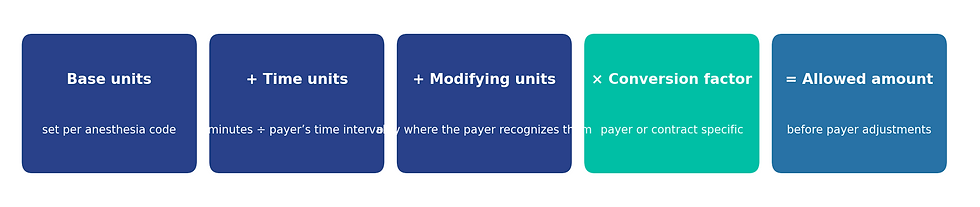
Base and time units | Base units are set per anesthesia code; time units come from minutes billed |
Physical status (P1–P6) | Reflects patient health; whether units are paid depends on the payer |
Common modifiers | AA (anesthesiologist personally performed), QK (medical direction of two to four concurrent cases), QY (direction of one CRNA), QX (CRNA with direction), QZ (CRNA without direction), QS (monitored anesthesia care). They are not interchangeable |
Medical direction and concurrency | Documentation of presence and supervision affects modifier choice and payment |
CPT and ICD-10 | Anesthesia CPT codes pair with procedure-supported diagnoses |
Payers | Medicare, Medi-Cal, and commercial plans each differ; see CMS anesthesia resources |
Where Can Anesthesia Practices Lose Revenue?

Revenue leakage area | Common problem | RCM improvement opportunity |
Time documentation | Missing or inconsistent time records | Documentation review |
Modifier selection | Incorrect modifier assignment | Coding validation |
Base units | Incorrect unit calculation | Reimbursement review |
Eligibility | Inactive or inaccurate coverage | Eligibility verification |
Claim submission | Missing or incorrect information | Claim scrubbing |
Denials | Repeated unresolved reasons | Root-cause denial management |
Underpayments | Incorrect or incomplete payment | Payment variance analysis |
A/R | Delayed follow-up | Structured A/R management |
Each gap has operational consequences, such as rework or delayed cash. No specific recovery amount is implied.
Is Your Anesthesia Billing Process Ready for 2026?
☐ Anesthesia time is accurately documented
☐ Base and time units are reviewed
☐ Appropriate modifiers are assigned
☐ Medical direction documentation is reviewed
☐ Claims are checked before submission
☐ Eligibility is verified
☐ Denials are categorized and monitored
☐ Underpayments are investigated
☐ Aged A/R is regularly reviewed
☐ Payer-specific requirements are monitored
☐ Coding and documentation audits are conducted
☐ Management receives useful RCM reports
Completed: ____ of 12 (divide by 12 for your percentage). Under 6 suggests starting with your largest gap; 6–10 suggests tightening specific steps; 11–12 suggests maintaining regular review.
How Strong Is Your Anesthesia Revenue Cycle?
☐ Are claims reviewed for modifier accuracy?
☐ Is time documentation consistently checked?
☐ Are denials tracked by reason?
☐ Are underpayments identified?
☐ Is aged A/R reviewed regularly?
☐ Are payer requirements monitored?
☐ Are coding and documentation audits performed?
Yes answers | Interpretation |
0–2 | Several workflow areas may need attention |
3–5 | Consider reviewing specific RCM processes |
6–7 | Maintain regular monitoring and improvement |
Educational self-assessment only. It is not a financial audit or a performance guarantee.
In-House vs. Outsourced Anesthesia Billing
Factor | In-house | Outsourced |
Staffing | Internal hiring and training | External billing team |
Technology | Practice-managed systems | Depends on vendor |
Coding expertise | Depends on internal staff | Depends on vendor |
Denial management | Internal workflow | Vendor-supported workflow |
Reporting | Internal tools | Vendor reporting |
Scalability | Depends on staffing | Depends on the agreement |
Cost structure | Payroll and operating expenses | Contract-based fees |
The right model depends on practice size, complexity, staffing, and priorities. Outsourcing is not better for every group.
How to Choose an Anesthesia Billing Company in California
Look for anesthesia-specific experience, CPT and modifier expertise, Medicare, Medi-Cal, and commercial payer knowledge, HIPAA and security practices, denial and underpayment processes, A/R reporting, EHR integration, dedicated support, transparent pricing, and contract flexibility. Ask each vendor:
• Who codes our anesthesia claims, and what is their anesthesia experience?
• How do you handle time, concurrency, and medical direction documentation?
• How do you find underpayments, and what reports will we see?
• What are the contract terms, fees, and exit provisions?
• Can you provide California references?
Frequently Asked Questions
▸ What are the best anesthesia billing companies in California?
It depends on your size, payers, and systems. Use the criteria above and confirm California experience with references.
▸ What does an anesthesia billing company do?
It handles coding, claim submission, denial follow-up, payment posting, and A/R for anesthesia services.
▸ How much do anesthesia billing services cost?
Pricing varies by contract, volume, and scope. Request written quotes.
▸ Why is anesthesia billing different?
Payment combines units and time rather than a single procedure fee.
▸ What CPT codes are commonly used?
Anesthesia codes (00100–01999) are chosen by the surgical procedure and site. Confirm current descriptors.
▸ What are common modifiers?
AA, QK, QX, QY, QZ, and QS, plus physical status modifiers P1–P6 where applicable.
▸ How are time units calculated?
From documented anesthesia minutes, using the payer’s time interval and rules.
▸ Why do anesthesia claims get denied?
Common causes include time or modifier errors, eligibility problems, and missing documentation.
▸ Should practices outsource billing?
Not always. Compare internal capacity, expertise, and cost.
▸ How can practices improve their revenue cycle?
Audit documentation, review modifiers, track denials, and monitor A/R regularly.
▸ Does Sirius Solutions Global provide billing and RCM services?
Yes. See our services. We have not claimed anesthesia-specialty results.
Disclaimer: This article is educational, published by Sirius Solutions Global, a company included in the comparison, so it is not independent. It is not an endorsement, ranking, or award, and it is not legal, compliance, financial, or coding advice. Company information comes from public sources and may be outdated or incomplete. We make no claims about other companies’ performance or pricing. Names are property of their owners. Results depend on each practice, and nothing here guarantees reimbursement.


