Acupuncture Insurance Billing Guide for Texas Providers


Texas Acupuncture Practices Are Bleeding Revenue and Most Do Not Know Where.
Here is a question worth sitting with for a moment.
When did you last pull a report showing your actual collection rate by payer? Not your billed charges. Not your scheduled fees. Your actual collected revenue as a percentage of what you were owed.
If the answer is "not recently" or worse, "never", there is a strong chance your Texas acupuncture practice is collecting somewhere between 60 and 75 cents of every dollar it earns. The rest disappears into denials, underpayments, timely filing losses, and claims that were never worked after they came back wrong the first time.
Texas makes acupuncture billing more complicated than most states. BCBS Texas, Aetna, United Healthcare, Cigna, Ambetter, Scott & White, and several regional MCOs all operate under different coverage policies, different prior auth workflows, and different documentation standards. What works for a BCBS Texas claim will not work on an Ambetter claim. What one plan covers in Dallas may not be covered under the same company's plan in Houston.
This guide is built for Texas acupuncture providers specifically, how major payers handle coverage, what Texas auditors actually look for, where denials are happening, and what a billing workflow that protects revenue looks like in 2026.
Texas has no statewide mandate requiring commercial insurers to cover acupuncture. That single fact shapes everything.
States with mandates let providers assume coverage exists and focus on documentation. In Texas, coverage must be verified for every patient on every plan, two patients with the same insurer and different plan types may have completely different acupuncture benefits.
Texas also carries a higher proportion of employer self-funded plans than most states. Self-funded plans are governed by ERISA, not Texas state insurance law, so a BCBS Texas ID card does not guarantee BCBS Texas coverage rules apply to that patient's claim. The employer's plan terms govern.
Assumptions kill revenue in Texas acupuncture billing. The provider assuming coverage exists, assuming prior auth is not required, or assuming the same rules apply across all BCBS members is booking sessions that will come back denied.
Blue Cross Blue Shield of Texas

BCBS Texas covers acupuncture under many commercial plans, not all and coverage terms vary significantly by plan type.
Typical coverage: Pain management conditions including chronic low back pain, neck pain, and headaches. 20 to 30 visits per calendar year under most PPO plans. Prior auth required on many plans, verify per patient, not per company.
What gets denied: Claims without required auth. Unit counts that do not match documented active contact time. Diagnostic codes not on the plan's specific covered list, BCBS Texas plan lists differ from company-wide default policy.
Audit focus: Treatment plans, functional outcome measures, and progress notes showing measurable improvement. Identical template notes across visits are flagged on medical review.
Aetna Texas

More consistent coverage than some Texas payers but specific rules catch practices off guard.
Coverage: Neuromusculoskeletal conditions and pain diagnoses. Visit limits of 20 to 60 per year depending on plan tier. Chemotherapy-induced nausea covered on many plans with appropriate ICD-10 documentation.
Critical Aetna rules: Provider must be credentialed specifically for acupuncture, general credentialing does not include acupuncture billing rights. Aetna's medical necessity criteria go beyond diagnosis matching, the clinical documentation must reflect the rationale for treatment. Concurrent review required on many plans after initial authorized visits.
United Healthcare Texas

Expanded coverage in recent years but stricter documentation requirements than most Texas payers.
Coverage: Most UHC Choice Plus and Options PPO plans. Prior auth must specify diagnosis, treatment frequency, and planned visit count. UHC updates its acupuncture benefit policy document annually, practices should verify they are using the current version.
Where UHC claims fail: Treatment frequency or visit count exceeds what was authorized. Functional outcome measures not documented at each re-evaluation. UHC requires this for ongoing coverage. Billing 97813/97814 when the note does not specify e-stim was used that session.
Ambetter (Centene) Texas

Dominant ACA marketplace insurer in Texas. Covers acupuncture on many silver and gold tier plans but with less generous terms than major commercial plans.
Key Ambetter rules: Coverage and visit limits vary by metal tier, verify per plan. Prior auth required on virtually all acupuncture claims. Timely filing window is 90 days from date of service, shorter than most providers realize, and a consistent source of write-offs for practices that batch Ambetter claims.
The post-payment audit trap: Ambetter recoupes claims months after initial payment when documentation does not support the billed service on audit. A paid claim is not protected revenue until the documentation would survive review.
Scott & White Health Plan

Covers a significant patient population in Austin, Waco, and Temple markets. Acupuncture is not uniformly included, verify per plan. Auth is handled by their behavioral health and complementary care team, separately from standard medical authorization. Visit limits are tighter than most commercial payers, commonly 12 to 20 per year, making visit count tracking critical.

Texas commercial payers have increased acupuncture audit activity since 2022. The patterns are consistent across payers, and the documentation gaps that generate recoupment requests are the same ones that appear in practices across the state.
What Texas Payer Audits Look For
Functional outcome scores at every evaluation. BCBS Texas, UHC, and Aetna pull progress notes checking for validated scores. "Patient reports improvement" does not pass. The note must show a number, Numeric Pain Rating Scale, Oswestry, PROMIS, compared to the prior documented score, with a trend that supports continued medical necessity.
Active contact time versus appointment time. The most common discrepancy in Texas acupuncture audits. Billed units imply one number, the note documents another. Any conflict is a recoupment finding.
Treatment plan currency. Payers expect an updated plan, not the initial assessment still in place six months later. A stale treatment plan removes medical necessity support from every claim it covers.
Provider credential match. Licensed acupuncturists (LAc), doctors of Oriental medicine (DOM), and physicians billing acupuncture services each have different NPI taxonomy codes and billing rules in Texas. A credential mismatch triggers denials or audit flags across all major Texas payers.
Prior auth is not a one-time task. For most Texas commercial payers, it is an ongoing process and the breakdown usually happens not at the first authorization request but at the concurrent review stage.
A practice obtains initial authorization for 12 visits. Visits 1 through 12 are delivered and billed. Nobody tracks the expiration. The patient continues. Visits 13 through 18 go out without concurrent review authorization because the billing team assumed the original auth covered ongoing care. Six claims come back denied.
This repeats in Texas practices constantly. The fix is not complicated, it is a tracking system with alerts tied to auth expiration and visit count.
Texas payer-specific rules:
BCBS Texas authorizes in blocks of 10 to 20 visits, track the block, not just the initial approval
UHC concurrent review must include updated clinical documentation, a phone call alone does not satisfy the requirement
Aetna may require a peer-to-peer review if ongoing coverage is questioned, the treating provider needs to be available, not just the billing team
A provider who is not credentialed with a payer cannot bill that payer. This is obvious. What is less obvious is how many Texas acupuncture practices have credentialing gaps that are silently generating denials.
New provider joins before credentialing is complete. Patients are scheduled, sessions delivered, claims go out under the new NPI, payer returns them all denied. Texas payers will not backdate credentialing. Those claims are unrecoverable.
Provider adds a new payer mid-year. Credentialing takes 60 to 120 days with most major Texas payers. Claims submitted during that window come back denied. The practice assumes it is a coding issue and keeps resubmitting, missing the actual cause entirely.
LAc billing under a supervising physician's NPI. Texas supervision and billing rules for acupuncture services provided by a licensed acupuncturist under physician oversight vary by payer. What one payer accepts, another denies. Billing all acupuncture under a single physician NPI without payer-specific verification creates claims that will not survive audit.
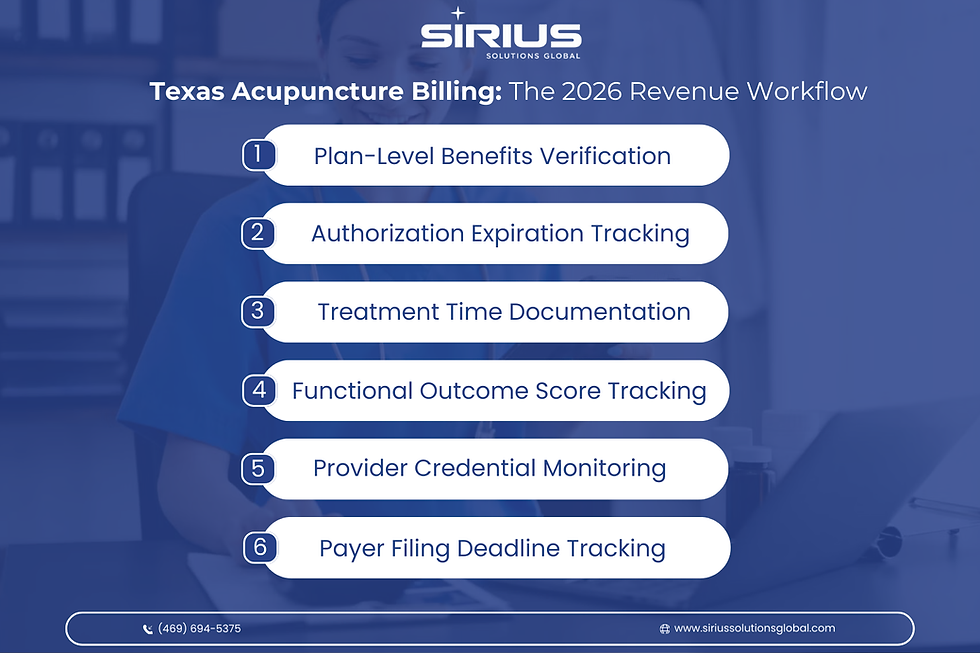
These are the components that separate practices collecting 85 cents on the dollar from practices collecting 65 cents:
Plan-level benefits verification before every first visit — not company-level. Coverage existence, prior auth requirements, visit limits, and covered diagnosis codes for the specific plan in the patient's hand.
Prior auth tracking with expiration alerts — tied to visit count and auth expiration date, with flags when either is within 2 to 3 visits of the limit.
Active contact time as a standalone documented number in every note — not buried in narrative, not implied by appointment length. A number that maps directly to the units billed.
Functional outcome scores with prior score comparison at every evaluation — not just documented at intake and referenced generically afterward.
Credential verification per provider per payer — in a tracking system, confirmed and current, not assumed.
Timely filing calendar by payer — Ambetter's 90-day window is not UHC's 180-day window, and the 91st day to Ambetter is an unrecoverable write-off.
Texas acupuncture practices that address the billing failures in this guide consistently collect 10 to 18 percentage points more of their billed revenue.
At 12 patients per day, five days a week, billing an average of $140 per visit, a 12-point improvement in collection rate is $56,448 per year. Not from more patients. From collecting what is already being earned.
A well-run Texas acupuncture billing workflow should produce a denial rate below 7 percent. Most practices without systematic billing support run at 18 to 25 percent and assume that is normal. It is not, it is the gap between where the practice is and where it should be.
Working With Sirius Solutions Global on Texas Acupuncture Billing
Texas acupuncture billing requires payer-specific knowledge, not generic acupuncture billing applied to Texas claims.
At Sirius Solutions Global, we handle prior auth tracking and concurrent review workflows for each major Texas commercial payer, manage credentialing verification across the provider roster, and review every acupuncture claim for active contact time consistency before it submits. Ambetter's 90-day timely filing window is tracked separately from commercial payer windows. BCBS Texas plan-specific coverage is verified, not just BCBS company-wide policy.
Coverage policies, prior auth requirements, and timely filing windows reflect 2026 payer guidelines for Texas markets. Verify current requirements directly with each payer before submitting claims.